


Think all tied Champions League groups get settled by goal difference? Think again.
UEFA uses two separate systems: knockout ties go to 30 minutes extra time and then penalties, while group-stage ties follow a ten-step checklist that starts with head-to-head results.
This quick guide explains those steps, how the head-to-head mini-league (only matches between tied teams) works, and why the away-goals rule no longer decides outcomes.
We’ll also show the real-game impacts: who benefits, who loses minutes, and what to watch on matchday.
UEFA Champions League Tiebreaker Rules Explained (Quick Guide)
UEFA splits its tiebreaker systems into two tracks: knockout rounds and group stages. When a two-legged knockout tie ends level after 180 minutes, you get extra time and then penalties. When teams finish on the same points in a group, UEFA runs through a ten-step list that starts with head-to-head results and ends with club coefficient rankings.
Group stage tiebreaker order (applied step by step until one separates the teams):
- Head-to-head points among tied teams
- Head-to-head goal difference among tied teams
- Head-to-head goals scored among tied teams
- Overall goal difference across all group matches
- Overall goals scored across all group matches
- Away wins across all group matches
- Disciplinary points (yellow card = 1 point, red card = 3 points, lower total wins)
- UEFA club coefficient
- Fair play conduct score
- Drawing of lots
Knockout round tie resolution:
- If level after two legs and 180 minutes, teams play 30 minutes extra time
- Extra time is two halves of 15 minutes each
- If still level after extra time, a penalty shootout decides the winner
How Knockout Round Ties Are Decided

Extra time kicks off right after the second leg finishes level on aggregate. Teams play two 15-minute halves with a quick break between them. Both teams stay on the pitch, and substitutes are still available if the team’s got allocation left under match day rules. There’s no golden goal or sudden death here. The full 30 minutes get played no matter what.
If it’s still tied after extra time, the referee orders penalties. Each team takes five kicks in alternating order. Still tied after five each? It goes to sudden death, one kick per team per round until someone scores and the other misses. All outfield players who finished extra time on the pitch can take penalties, plus the goalkeeper. The same player can’t take a second penalty until all eligible teammates have taken one.
The away goals rule, which used to give an edge to goals scored away from home during extra time, got scrapped by UEFA in June 2021. Extra time and penalties now apply the same way no matter which team is home or away in the second leg.
Match procedure when knockout scores remain level:
- Referee checks aggregate score after second leg full time
- If level, teams prepare for 30 minutes extra time without delay
- Extra time is played as two 15-minute halves with a brief interval
- If still level after extra time, teams go straight to penalties
- Penalty shootout continues until one team holds an insurmountable lead or sudden death rounds produce a winner
Group Stage Tiebreakers in Detail
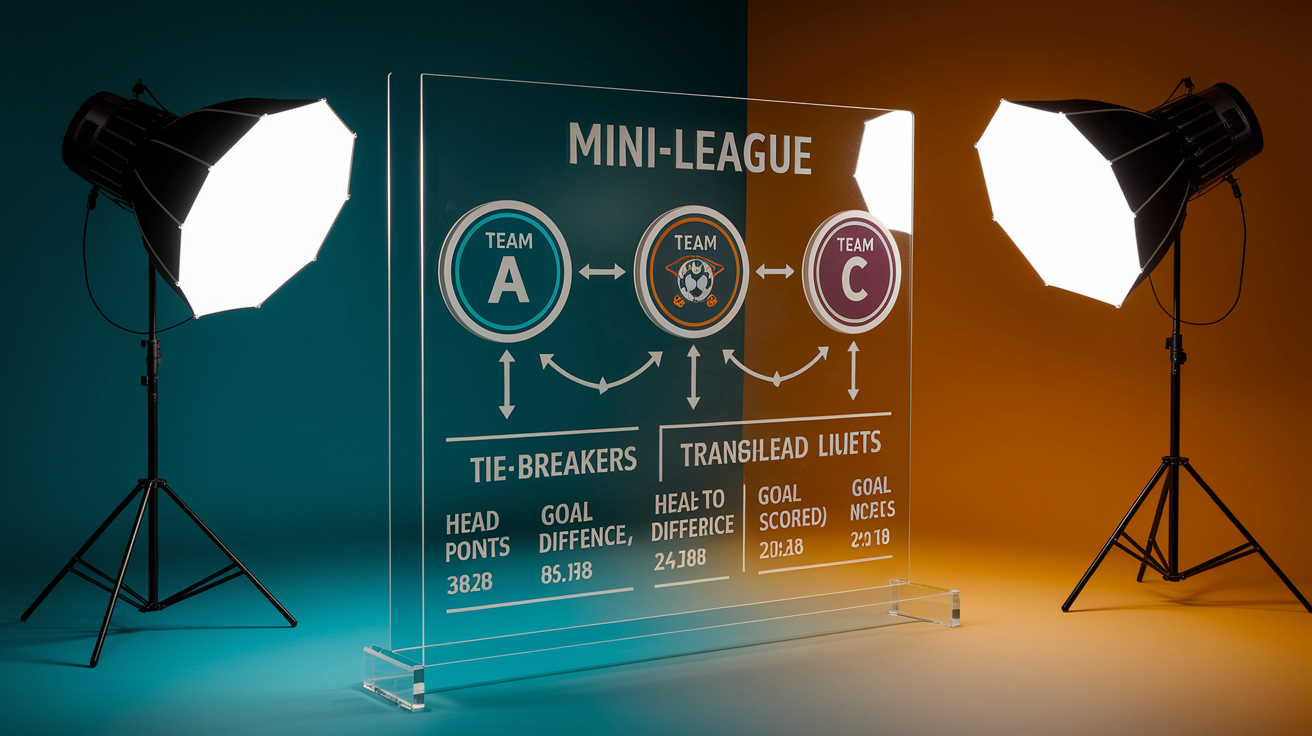
Head-to-head results settle group stage ties before overall goal metrics get looked at. When two or more teams finish level on points, UEFA isolates the tied teams into a “mini league” and compares only the results from matches those teams played against each other. Points earned in those head-to-head fixtures form the first test. Still tied? Goal difference in those matches comes next, followed by goals scored head-to-head.
This mini league setup stops a team’s performances against weaker opponents from overshadowing direct results between contenders. So if Team A beat Team B home and away, Team A ranks higher even if Team B posted a better overall goal difference by scoring heavily against the group’s bottom side. Only when head-to-head records stay identical does UEFA move to overall group statistics.
Disciplinary points show up late in the tiebreaker sequence, but they matter when sporting metrics run out. Each yellow card adds one disciplinary point to a team’s total. Each red card or dismissal adds three. The team with the lower total wins the tiebreaker. In rare cases where disciplinary records also match, UEFA applies the club’s five year coefficient ranking. If coefficients are equal, fair play scores and finally a draw of lots get used.
| Criterion | Description | Applied When |
|---|---|---|
| Head-to-head points | Points earned in matches between tied teams only | First tiebreaker among tied clubs |
| Head-to-head goal difference | Goals scored minus goals conceded in head-to-head matches | If head-to-head points are equal |
| Head-to-head goals scored | Total goals scored in matches between tied teams | If head-to-head goal difference is equal |
| Overall goal difference | Goals scored minus conceded across all six group matches | If head-to-head criteria don’t separate teams |
| Overall goals scored | Total goals scored across all six group matches | If overall goal difference is equal |
| Away wins | Number of wins achieved in away group matches | If overall goals scored is equal |
| Disciplinary points | Lower total wins (yellow = 1 pt, red = 3 pts) | If sporting metrics don’t resolve the tie |
| UEFA club coefficient | Five year ranking based on European results | If disciplinary totals are equal |
Examples of Real World Tiebreak Scenarios
Real match situations show how the tiebreaker ladder resolves uncertainty. Walking through concrete cases makes the ten step hierarchy easier to remember and apply during live group stage drama.
Scenario A: Two team tie
- Team X and Team Y both finish on 10 points
- Head-to-head: Team X won 2–1 at home, Team Y won 1–0 away
- Head-to-head points: both teams earned 3 points (one win each)
- Head-to-head goal difference: Team X +1 (scored 2, conceded 1), Team Y 0 (scored 1, conceded 2)
- Team X ranks higher on head-to-head goal difference
- Overall group goal difference doesn’t get consulted
Scenario B: Three team mini league tie
- Team A, Team B, and Team C all finish on 9 points
- Head-to-head mini league results: A beat B 2–0, C beat A 1–0, B beat C 3–1
- Mini league points: A = 3, B = 3, C = 3 (each won one match in the triangle)
- Mini league goal difference: A +1, B +2, C –3
- Team B ranks first (best mini league goal difference), Team A second, Team C third
- Overall group metrics aren’t consulted because the mini league resolved the tie
Examples like these cut through confusion because they show that UEFA’s rules prioritize direct competition before rewarding teams for beating weaker opponents. The head-to-head mini league resets the comparison so only the most relevant matches count.
How UEFA’s Rules Have Changed Over Time
In June 2021 UEFA removed the away goals rule from all club competitions. Previously, if a knockout tie finished level on aggregate after two legs, the team that scored more away goals advanced without extra time. The abolition means every knockout tie now plays the full 30 minutes of extra time if needed, reducing the influence of venue and travel factors and creating a more balanced resolution process.
Disciplinary tiebreaker formulas and coefficient calculations have been updated several times since 2015 to reflect changes in competition format and fair play regulations. The introduction of the UEFA Conference League in 2021 altered coefficient distribution across more clubs, and yellow card thresholds for suspensions were adjusted to discourage cynical fouls. These updates keep tiebreaker criteria in step with the modern game’s tactical and administrative landscape.
Final Words
Tied on points? We ran through both group and knockout procedures, with head-to-head first in the group stage, then overall goal difference, goals scored, away wins, disciplinary points, and coefficients.
We also broke down knockout resolution: 90 minutes, two 15-minute halves of extra time, then penalties if needed. Real examples showed how two-team and three-team ties get sorted.
With UEFA Champions League tiebreaker rules explained, you’ll know what to watch on matchday and why coaches make certain moves. Enjoy the next game, and follow the drama with confidence.
FAQ
Q: What are the tie breaker rules for the Champions League?
A: The tie breaker rules for the Champions League: group stage uses this order — head-to-head points; head-to-head goal difference; head-to-head goals scored; overall goal difference; overall goals scored; away wins; disciplinary points; coefficient ranking. Knockouts: extra time, penalties.
Q: What happens if aggregate is tied in the Champions League? Do Champions League ties go to extra time?
A: If aggregate is tied, the match proceeds to two 15-minute extra time halves, then a penalty shootout if still level; the away-goals rule was removed in 2021.
Q: What happens if two teams have the same points in the Champions League?
A: If two teams finish level on points, UEFA applies head-to-head criteria first: points between them, then head-to-head goal difference, then head-to-head goals scored; then overall group metrics if still tied.