

Think suspension is just about a smooth ride?
It does a lot more: it keeps tyres on the road so you can accelerate, brake, and corner without losing control.
This explainer cuts through the noise and shows how suspension works step by step — how springs store impact, how dampers stop the bounce, and why different systems (coil, leaf, torsion, air, multi-link, double wishbone) change handling, load capacity, and comfort.
By the end you’ll know what matters when a car feels planted or floaty.
Core Suspension Explanation and How Suspension Systems Work
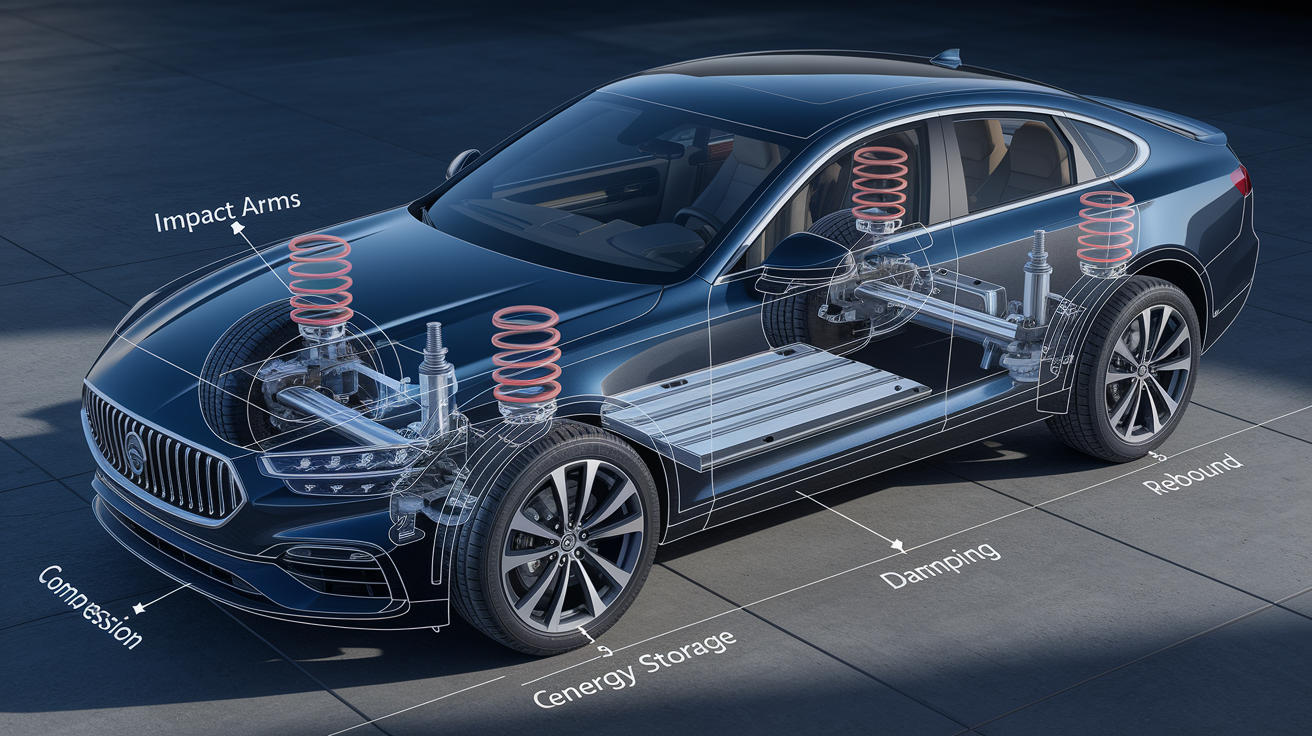
Suspension sits between your car’s body and its wheels. It’s there to soak up bumps and keep rubber glued to the road. The whole point? Grip. More contact between tyre and tarmac means better acceleration, sharper braking, faster cornering. Without it, every pothole sends energy straight into the chassis, lifts the tyres off the ground, and you lose control. Whether you’re dodging potholes on your commute or carrying downforce through a fast corner, suspension keeps wheels planted and you in charge.
Energy gets absorbed in two stages. Springs store the impact, dampers kill the bounce. Wheel hits a bump, spring compresses to catch that energy, then releases it without throwing the car skyward. Dampers use oil or gas under pressure to slow the spring’s movement and stop the car bouncing like a trampoline. In Formula 1, torsion springs sit horizontally and twist under load instead of squashing vertically. Saves space, handles extreme downforce. Teams also run negative camber, tilting the top of the tyre inward so the contact patch stays flat when cornering loads pile on. The principle’s the same everywhere: absorb, control, settle.
How suspension reacts to a bump:
- Impact – Wheel meets raised surface, tyre and wheel assembly get pushed upward relative to the chassis.
- Compression – Spring (coil, leaf, torsion, or air) compresses, storing kinetic energy from the hit.
- Energy storage – Compressed spring holds that energy briefly, keeps the full force from smashing through to the cabin.
- Damping – Damper resists the spring’s release, turns stored energy into heat, slows the rebound.
- Rebound – Spring extends back to resting position in a controlled motion, ready for the next input.
Adaptability pushes the concept further. Air suspension swaps steel springs for pressurized rubber bags, letting you adjust ride height and stiffness on demand. Raise the front a few inches to clear a steep driveway, drop the body for better aero at highway speed. Variable damping can firm up for spirited driving or soften for comfort, all managed by an electronic control unit reading sensors across the chassis. This real-time tuning improves stability, cuts body roll, and tailors the ride to road conditions without touching a spanner.
Types of Suspension Systems Explained
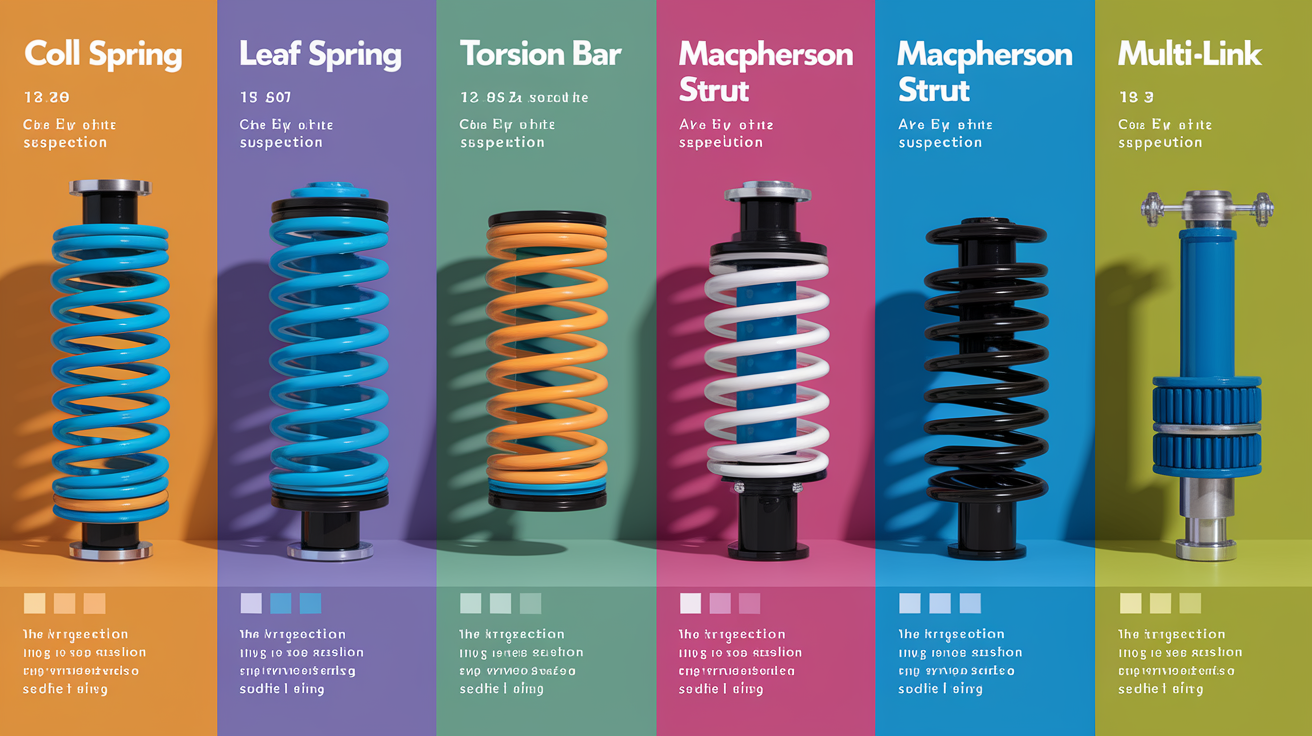
Vehicle suspension comes in several distinct forms, each built for specific loads, packaging limits, and performance goals. Understanding the trade-offs explains why a sports car and a heavy-duty truck feel so different on the same stretch of road.
Coil Spring Suspension
Coil springs are the default on most passenger cars. Each wheel mounts to the chassis via a coiled steel spring that compresses vertically under load. Coilovers (coil-over-shock) combine the spring and damper into a single adjustable unit, letting enthusiasts dial in ride height and stiffness for performance or stance builds. Design’s simple, durable, and cheap, which is why it dominates mainstream stuff.
Leaf Spring Suspension
Leaf springs stack multiple curved steel plates (called leaves) on top of one another, clamped together at the center. The assembly bolts to the axle beneath and flexes to absorb vertical movement. This setup’s brilliant at carrying heavy loads, which is why it’s common on pickup trucks, vans, and older SUVs. You can add or remove leaves to adjust load capacity, but the ride’s typically firmer and less refined than coil setups. Trade-off for towing and hauling capability.
Torsion Bar Suspension
A torsion bar’s a horizontal steel rod anchored at one end to the chassis, connected at the other to the wheel’s control arm. When the wheel moves up, the bar twists, storing energy through torsion rather than compression. Adjusting the bar’s anchor point changes ride height and preload, useful for off-road setups and drag racing to fine-tune launch angle. Downside is added complexity and a tendency toward uneven wear if the bar twists unevenly along its length.
MacPherson Strut Suspension
The MacPherson strut integrates the coil spring, shock absorber, and upper steering pivot into one compact vertical assembly. Saves space and cuts part count, making it ideal for front-wheel-drive and unibody vehicles where engine packaging’s tight. The strut acts as both a structural member and a damper. When one component wears (spring, damper, or mount), the entire unit often needs replacing. Compared to double wishbone designs, MacPherson struts allow more body roll and offer less precise control, but they’re cheaper to make and easier to package.
Air Suspension
Air suspension replaces coil or leaf springs with rubber air bags (basically reinforced balloons) inflated by an onboard compressor. Ride height and firmness adjust in real time via drive modes or manual controls. Luxury sedans, performance SUVs, and even some semi-trucks use air systems to balance comfort and capability. Low-clearance sports cars can lift the front a few inches to clear speed bumps, then drop back down for aerodynamic efficiency. Smoothest ride in the suspension world typically comes from air, but complexity and moisture sensitivity bring maintenance headaches.
Multi-Link Suspension
Multi-link setups use three or more separate control arms (or links) to connect the wheel hub to the chassis. Each link isolates a specific motion: camber change, toe change, lateral location, fore-aft compliance. This decoupling lets engineers tune spring rates, damping, and steering geometry independently, delivering both comfort and sharp handling. High-end performance and luxury cars rely on multi-link rear suspensions to keep tyres flat through corners while soaking up road imperfections.
Double Wishbone Suspension
Double wishbone (also called A-arm or double A-arm) uses two wishbone-shaped control arms, one above and one below the wheel, connected by a vertical shock and coil spring. The geometry offers precise control over camber, caster, and wheel movement, keeping the tyre’s contact patch stable through suspension travel. Sports cars and racing applications favor this layout because it maximizes grip and allows fine-tuning of roll centers and anti-dive characteristics. Trade-off is cost and packaging complexity compared to simpler strut designs.
| System Type | Main Advantage |
|---|---|
| Coil Spring | Simple, reliable, cost-effective for everyday use |
| Leaf Spring | High load capacity, adjustable by adding/removing leaves |
| Torsion Bar | Adjustable ride height, compact for off-road builds |
| MacPherson Strut | Space-saving, low part count, affordable |
| Air Suspension | Variable height and stiffness, smoothest ride |
| Multi-Link | Highly tunable, decouples wheel motions for comfort and control |
| Double Wishbone | Superior handling precision, optimal tyre contact |
Key Suspension Components and Their Functions
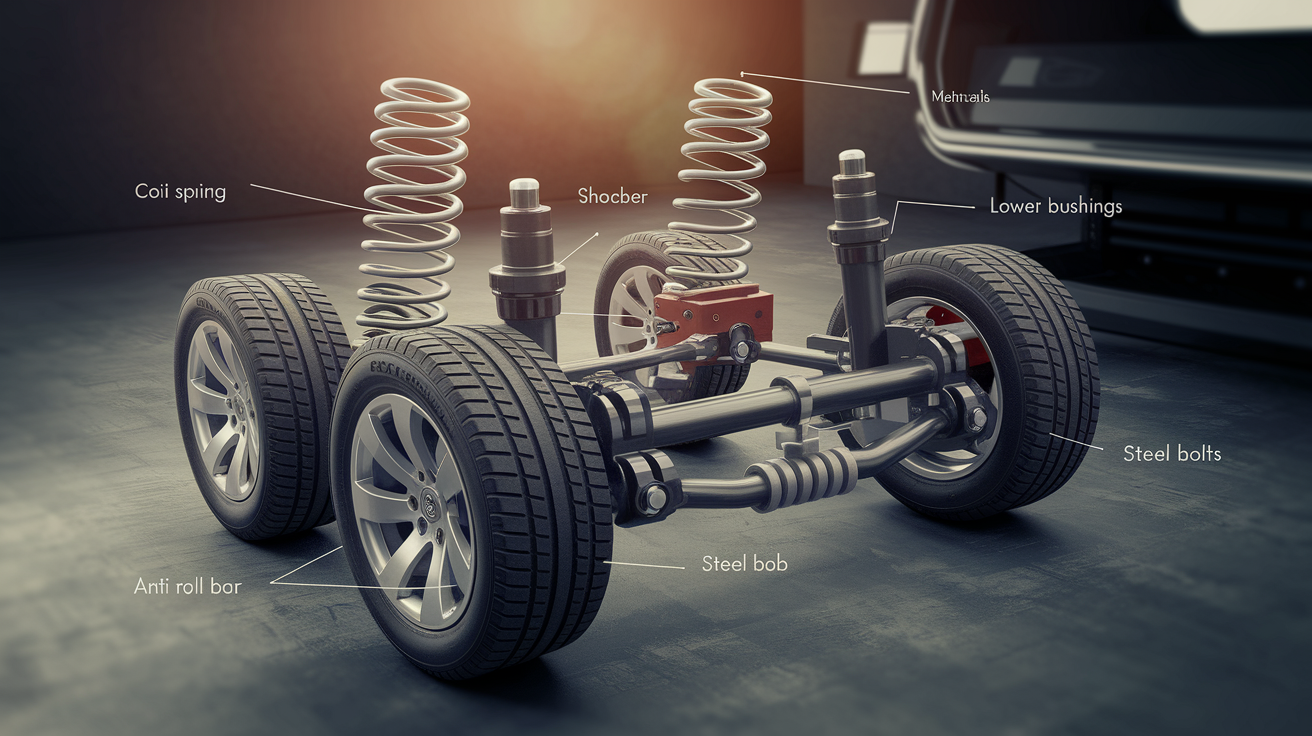
Springs are the energy-storage medium. Coil springs compress vertically, leaf springs flex in an arc, torsion bars twist along their axis, air springs inflate or deflate under pressure. Each type absorbs the kinetic energy from a bump and releases it in a controlled manner, preventing that energy from jolting the chassis. Spring rate (measured in pounds per inch or Newtons per millimeter) determines how much force you need to compress the spring one unit of distance. Stiffer springs reduce body motion but transmit more harshness. Softer springs improve comfort but allow more roll and pitch.
Dampers (commonly called shocks or shock absorbers) use hydraulic fluid or pressurized gas to resist the spring’s motion. When the suspension compresses, fluid gets forced through small orifices inside the damper, converting kinetic energy into heat. Same resistance occurs during rebound, preventing the spring from bouncing the wheel off the road. Formula 1 dampers sit horizontally alongside the torsion spring, saving vertical space and lowering the center of gravity. Road cars typically mount dampers vertically inside or alongside the coil spring. Tuning damper valving (how fast fluid flows) changes how the car responds to bumps, cornering loads, and weight transfer.
Control arms and wishbones guide the wheel’s path as it moves up and down. A double wishbone layout uses an upper and lower arm to define camber and caster angles throughout suspension travel. MacPherson struts replace the upper arm with a sliding bearing inside the strut housing. Multi-link systems add extra arms to separate lateral, longitudinal, and vertical motions. Anti-roll bars (also called sway bars or stabilizer bars) connect the left and right wheels via a torsion bar. When one wheel compresses in a corner, the bar twists and lifts the opposite wheel slightly, resisting body roll and keeping the chassis flatter.
Air suspension systems add electronic complexity. The air compressor pressurizes rubber air springs (also called air struts or air bags) through a valve block assembly that routes air to each corner. Ride-height sensors tell the electronic control unit (ECU) how far each wheel sits relative to the body, and the ECU commands the compressor and valves to raise, lower, or level the vehicle. A rear axle distribution block balances pressure between the rear wheels. When the system works, it’s seamless. When moisture enters the compressor or a valve sticks, faults cascade quickly. More on that in the maintenance section.
Suspension Geometry and Alignment Explained
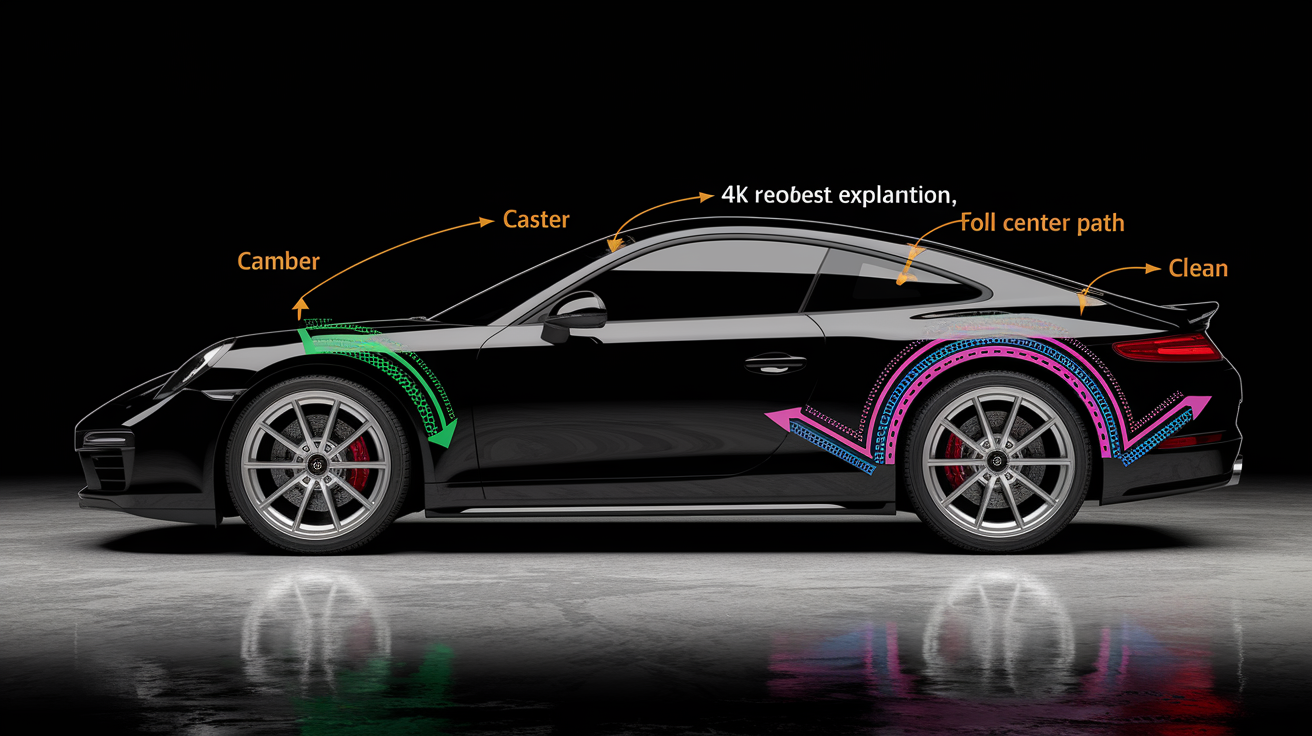
Suspension geometry defines how the wheel moves relative to the chassis and the road. Small changes in control-arm length, mounting angle, or pivot location alter camber curves, roll centers, scrub radius, and anti-dive characteristics. These parameters directly influence tyre contact, steering feel, and cornering balance. Formula 1 teams adjust geometry for every circuit. At Monaco, for example, they lengthen steering arms to increase lock-to-lock angle for the tight hairpins. Road cars lock geometry at the factory, but alignment settings remain adjustable within a range.
Four critical alignment angles:
- Camber – The inward or outward tilt of the tyre when viewed from the front. Negative camber tilts the top inward, increasing contact during cornering as the chassis rolls. Too much causes inside-edge tyre wear.
- Caster – The forward or rearward tilt of the steering axis when viewed from the side. Positive caster improves straight-line stability and adds self-centering torque to the steering wheel.
- Toe – The angle of the tyres when viewed from above. Toe-in points the fronts slightly inward. Toe-out points them outward. Toe affects turn-in response and tyre scrub.
- Roll center – The imaginary point around which the chassis rotates during cornering. Raising the roll center reduces body roll but can make the car feel twitchy. Lowering it increases roll but improves grip predictability.
Alignment adjustments affect every aspect of handling. Adding negative camber improves grip in corners but reduces straight-line contact and can increase wear. Increasing caster sharpens steering feedback and stability at speed. Dialing in slight toe-out at the front quickens turn-in but can make the car nervous on the highway. Alignment also determines tyre wear patterns. Camber wear shows on one edge, toe wear creates a sawtooth pattern across the tread. Proper alignment balances grip, stability, wear, and driver confidence within the limits of the suspension’s geometry.
Suspension Performance Factors and Handling Characteristics
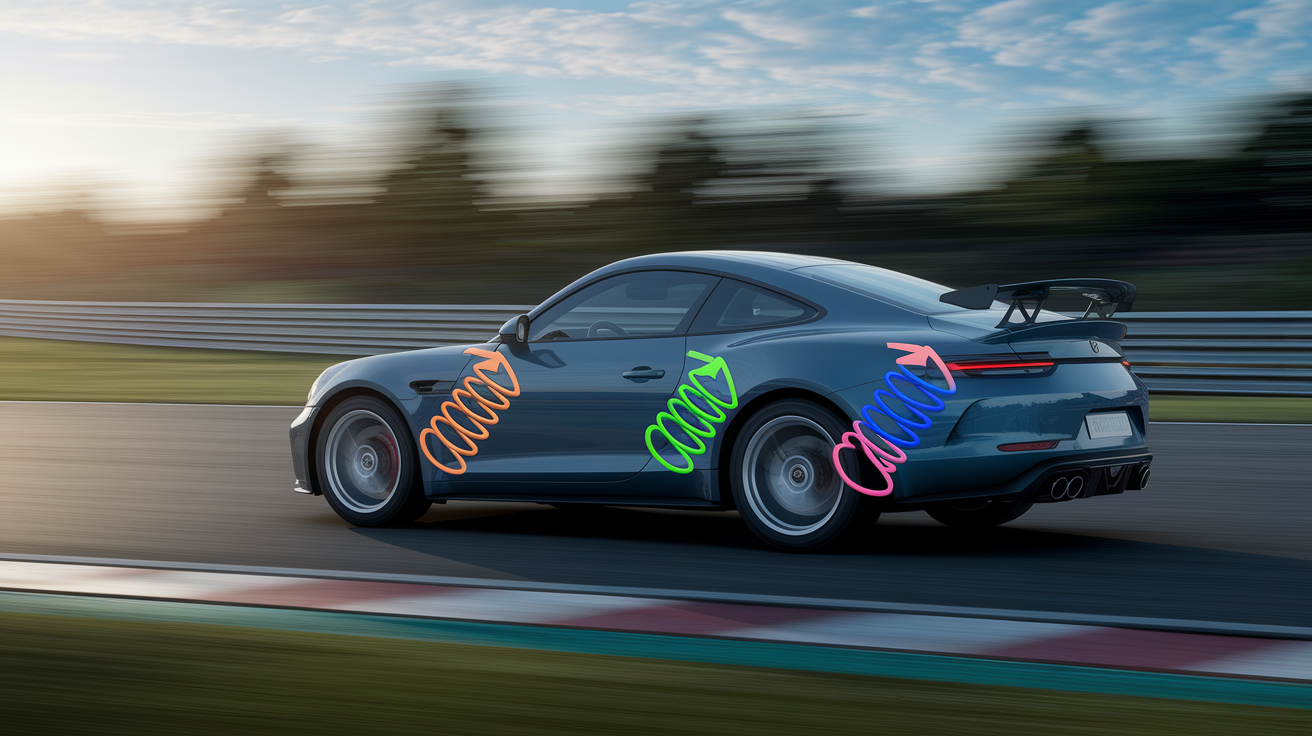
Body roll happens when lateral forces in a corner shift weight to the outside wheels, compressing that side’s suspension and extending the inside. The chassis tilts, the inside tyres lighten, and grip becomes unbalanced. Stiff springs and anti-roll bars resist this motion, keeping the body flatter and the contact patches more even. Squat occurs under acceleration when weight transfers rearward, compressing the rear suspension and lifting the front. Dive happens during braking, compressing the front and lightening the rear. All three motions (roll, squat, dive) are normal, but excessive movement reduces control and consistency.
Rebound and compression damping tune how the suspension reacts to these weight shifts. Compression damping controls how quickly the suspension compresses when a wheel hits a bump or a corner loads the outside tyres. Too soft and the car wallows. Too stiff and small bumps upset the chassis. Rebound damping controls how quickly the suspension extends after compression. Slow rebound keeps the tyre planted longer, improving mechanical grip. Fast rebound can make the car feel lively but risks wheel hop. Street cars bias toward comfort with softer compression and moderate rebound. Track cars run stiffer compression to minimize body motion and faster rebound to reset the suspension between corners.
Performance vehicles and racing series fine-tune geometry and damping for specific conditions. Formula 1 teams adjust damper curves, ride height, and anti-roll bar stiffness between practice sessions based on tyre temperatures and driver feedback. A soft setup might work at a smooth circuit like Barcelona, but bumpy tracks like Baku demand higher ride height and more compliant damping to prevent bottoming out. Road-focused sports cars offer adaptive damping with comfort, sport, and track modes. The ECU changes valve settings in milliseconds to match driving style. This adaptability lets one car serve multiple roles without requiring a full suspension swap.
Air Suspension Systems Explained (With Real-World AIRMATIC Examples)
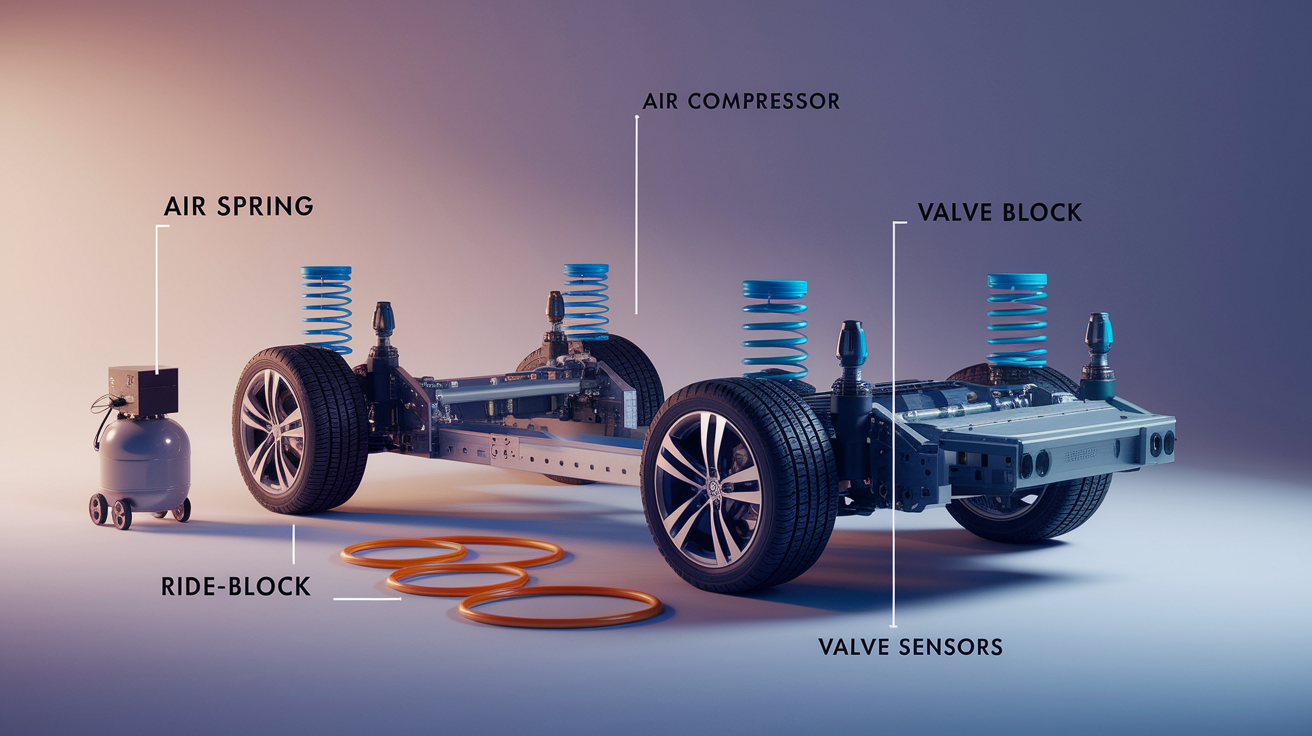
Air suspension trades steel springs for pressurized rubber bladders, offering variable ride height and stiffness that mechanical springs can’t match. Pneumatic systems use compressed air. Hydraulic systems use fluid pressure. Most modern road cars, including Mercedes-Benz AIRMATIC, rely on pneumatic designs because air’s lighter and easier to modulate. Hydraulic setups appear in some active systems and heavy equipment where higher pressure and precise control justify the added weight.
The core components work together as a closed loop. Air springs (also called air struts when integrated with a damper) replace coil springs at each corner. An electric compressor draws air from outside, pressurizes it, and sends it through a valve block assembly that directs air to the appropriate strut. The electronic control unit (ECU) reads data from ride-height sensors mounted near each wheel and commands the compressor and valves to raise, lower, or level the car. A rear axle distribution block balances pressure between the left and right rear struts to keep the rear level under asymmetric loads. The Basics of Air Suspension Systems provides a deeper dive into how air springs and compressor systems interact to deliver adjustable comfort.
Four major advantages of air suspension:
- Self-leveling – Sensors detect load and automatically adjust height to maintain ride quality and headlight aim, even with cargo or passengers.
- Height adjustment – Raise the vehicle for ground clearance over obstacles. Lower it for improved aerodynamics, reduced drag, and easier entry.
- Adaptability – Driver-selectable modes (comfort, sport, off-road) change damping and ride height on the fly.
- Load balancing – The system compensates for uneven weight distribution, keeping the chassis level and maintaining optimal suspension geometry.
Common failures center on moisture and wear. Moisture enters the compressor through the intake, corrodes internal components, and clogs the air dryer (a small desiccant cartridge designed to remove water vapor). When the dryer saturates, water reaches the valve block and air lines, causing rust, ice formation in cold weather, and sticky valves. A failing compressor runs continuously or makes grinding noises, and the dashboard displays suspension error messages. Air leaks show up as sagging at one corner (often overnight) or as hissing sounds near the struts or lines. Slow height adjustment indicates clogged valves, minor leaks, or an overworked compressor struggling to maintain pressure.
Real-world use case: The Mercedes-Benz CLS-Class (W219) came equipped with AIRMATIC as standard or optional depending on trim. The system includes ride-height adjustment and adaptive damping, managed by driver-selectable modes. Owners report typical failure points around 80,000 to 120,000 miles: air strut leaks at the rubber bladder, compressor relay failures, and moisture-related valve-block corrosion. Replacing a single air strut runs several hundred dollars in parts. A full compressor assembly can exceed a thousand. Other Mercedes lineups (S-Class, E-Class, GLE) use similar Adaptive Variable Suspension architecture, sharing many AIRMATIC components and failure modes.
Advanced and Active Suspension Technologies

Active suspension takes real-time adjustment beyond ride height and damping presets. Fully active systems use hydraulic actuators or electric motors at each corner to push and pull the wheel independently, counteracting body roll, pitch, and dive before they occur. Sensors measure steering angle, throttle position, brake pressure, and body acceleration dozens of times per second, feeding data to the ECU. The system then adjusts each corner’s force to keep the chassis flat and the tyres evenly loaded. Result is near-zero body roll in corners and minimal pitch under braking or acceleration, but the complexity and cost limit adoption to ultra-high-end vehicles.
Semi-active suspension uses electronically controlled dampers (often magnetorheological or solenoid-valve designs) that change damping force in milliseconds without altering spring rates or ride height. The ECU reads the same sensor inputs as a fully active system but only modulates the dampers, not the springs. Costs less and weighs less than full active control while still delivering significant improvements in ride quality and handling. Most adaptive suspension systems on mainstream luxury and performance cars fall into the semi-active category, offering multiple drive modes that adjust damper firmness on demand.
| Technology | Key Capability |
|---|---|
| Adaptive (semi-active) | Electronically adjustable dampers; driver-selectable modes; real-time response to road inputs |
| Semi-active (magnetorheological) | Magnetic-fluid dampers change viscosity instantly; millisecond response; no external pumps |
| Fully active | Hydraulic or electric actuators control each corner independently; near-zero body motion; highest cost and complexity |
Suspension Maintenance, Wear Symptoms, and Troubleshooting
Key signs of worn suspension appear gradually. Uneven tyre wear (cupping, scalloping, or edge feathering) indicates dampers that no longer control rebound, allowing tyres to bounce and scrub. Clunking or rattling over bumps points to worn bushings, loose control-arm bolts, or failed strut mounts. Increased body roll, longer stopping distances, and vague steering feel all signal that springs have sagged or dampers have lost their damping force. If the car dives hard under braking or squats excessively during acceleration, the suspension’s no longer controlling weight transfer effectively.
Air-system-specific symptoms are more dramatic. A sagging corner (often the rear on sedans) indicates a leaking air spring or a stuck valve that won’t hold pressure. If the vehicle sits noticeably lower in the morning after sitting overnight, air’s escaping somewhere. Slow or failed ride-height adjustments mean clogged valves, leaking lines, or a compressor struggling to build pressure. Continuous compressor operation (audible as a humming or whining from under the vehicle) signals a leak the system’s trying to compensate for, which will overheat and kill the compressor if ignored. Dashboard warnings like “Suspension Malfunction” or “AIRMATIC Visit Workshop” are the ECU’s way of saying it has detected a fault code.
Six-step troubleshooting checklist:
- Visual inspection – Walk around the vehicle and look for obvious sags, leaking fluid around dampers, cracked rubber boots on air struts, or damaged control-arm bushings.
- Alignment check – Measure camber, caster, and toe. Compare to factory specs. Out-of-spec alignment can indicate bent components or worn bushings.
- Scan for fault codes – Use a capable diagnostic scanner to read suspension ECU codes. Air systems store specific fault codes for compressor relays, valve blocks, and ride-height sensors.
- Leak detection – Spray soapy water on air lines, fittings, and strut bodies while the system’s pressurized. Bubbles reveal leaks. Listen for hissing around each corner.
- Ride-height measurement – Measure from the ground to a fixed point on each wheel arch. Compare corner to corner. Significant differences indicate a failing air spring or stuck valve.
- Air dryer inspection – Remove and inspect the compressor’s air dryer cartridge for moisture saturation, rust, or debris. Replace if saturated or older than five years.
When multiple symptoms appear together (sagging, compressor noise, slow height changes, and fault codes), the system’s close to failure. Address leaks and moisture issues immediately to prevent compressor burnout, which turns a few-hundred-dollar strut repair into a thousand-dollar compressor replacement.
Suspension Repair, Replacement Costs, and Service Options
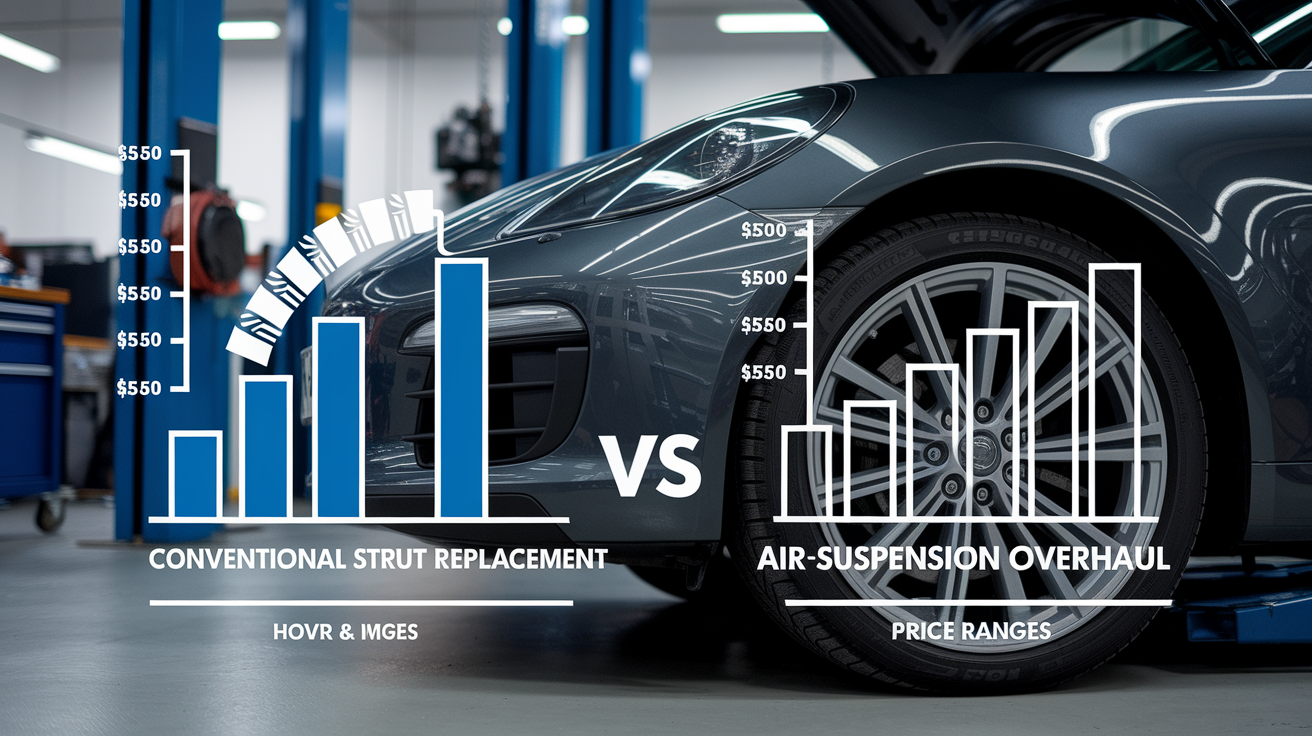
Repair cost swings widely based on damage extent, parts needed, and who does the work. Replacing a single conventional strut and coil spring on a mainstream sedan might run $300 to $600 per corner at an independent shop, including parts and labor. Air suspension components cost significantly more: a single air strut ranges from $400 to over $1,000 depending on the vehicle, and a compressor assembly can exceed $1,200. Valve blocks, ECUs, and height sensors add hundreds each. A full four-corner air-suspension overhaul on a luxury vehicle can approach $4,000 to $6,000 at a dealership.
Five required tools and safety considerations:
- Diagnostic scanner – Must read manufacturer-specific codes and perform calibration routines. Generic OBD-II scanners often lack suspension module access.
- Spring compressor – Essential for safely compressing coil springs during strut removal and installation. Improper use can cause serious injury.
- Torque wrench – Suspension fasteners require precise torque specs. Under- or over-tightening affects geometry and safety.
- Jack stands (rated capacity) – Never work under a vehicle supported only by a jack. Use stands rated for the vehicle’s weight, placed on solid jacking points.
- Safety protocols – Depressurize air systems before disconnecting lines. Wear eye protection when working with compressed springs or air. Follow all manufacturer service procedures.
Dealerships offer OEM parts, factory-trained technicians, and access to proprietary calibration software. They charge premium labor rates (often $150 to $200 per hour), but the work typically comes with a warranty and the assurance that alignment and calibration are done to spec. Independent mechanics charge lower labor rates, usually $80 to $120 per hour, and may source quality aftermarket parts at a discount. The key is verifying the shop has air-suspension experience and the correct diagnostic tools. Not all independents invest in brand-specific scanners. DIY’s possible for those with mechanical aptitude, proper tools, and a safe workspace, but mistakes (incorrect torque, skipped calibration, improper spring compression) can cause alignment issues, premature wear, or injury. Factor in the cost of tools and the value of your time when deciding.
Real-World Examples, Myths, and Helpful Suspension FAQs
Myths persist because suspension behavior isn’t always intuitive. One common misunderstanding is that leaf springs are inherently inferior to coil springs in all situations. True, leaf setups are less refined on rough pavement, but their load capacity and simplicity make them the best choice for heavy-duty trucks. Another confusion surrounds independent versus solid-axle designs: independent suspension allows each wheel to move separately, improving ride quality. A solid axle connects both wheels on an axle, so one wheel’s movement affects the other. Neither is universally “better.” Solid axles excel in rock crawling and towing, while independent setups dominate on-road comfort and handling. AIRMATIC failures on older Mercedes models have built a reputation for expensive repairs, but many issues trace back to deferred maintenance (ignoring early warning signs like slow height adjustment or skipping air-dryer replacement intervals).
Five frequently asked questions:
- What are the most common signs my suspension’s failing? – Uneven tyre wear, clunking noises over bumps, excessive body roll, one corner sagging (air systems), and longer stopping distances.
- Which suspension type gives the smoothest ride? – Air suspension, because it can adjust stiffness and height in real time to match road conditions and load.
- Can I convert my air suspension to coilovers? – Yes, conversion kits exist for many vehicles. You gain simplicity and lower maintenance cost but lose adjustable height, self-leveling, and adaptive damping.
- What’s the best suspension system overall? – No single answer. Air suspension for luxury comfort and adaptability, double wishbone for handling precision, leaf springs for heavy loads.
- How often should I get an alignment after suspension work? – Every time you replace a component that affects geometry (control arms, struts, springs) and at least once a year or every 10,000 to 12,000 miles as preventive maintenance.
Terms like camber, caster, toe, rebound damping, and roll center carry specific engineering meanings but often get used loosely in conversation. Camber is tyre tilt front-to-back. Caster is steering-axis tilt side-to-side. Toe is the inward or outward angle of the tyres from above. Rebound damping controls how fast the suspension extends after compression. Compression damping controls how fast it compresses. Roll center is the pivot point around which the chassis rotates during cornering. Knowing these definitions helps decode alignment reports, suspension tuning guides, and online forum advice without falling into the trap of half-understood jargon.
Final Words
You’re sitting in the driver’s seat: suspension keeps tyres planted, so bumps become predictable and the car goes where you point it.
We covered how systems work, the main types from coil to air, key components, geometry and tuning, air and active tech, plus maintenance, repair costs, and quick FAQs you can use.
This Explainer on suspensions gives you the basics to spot problems and make smarter service or upgrade choices. Go try what you learned and enjoy a smoother ride.
FAQ
Q: What is vehicle suspension and what does it do?
A: Vehicle suspension is the system that keeps tyres planted on the road, absorbs bumps, and controls body motion to deliver stability, ride comfort, and predictable handling during braking, steering, and acceleration.
Q: How does a suspension react to a bump?
A: The suspension reacts to a bump by taking the impact, compressing the spring to store energy, forcing fluid through the damper to dissipate energy, then letting the spring rebound while the damper controls oscillation.
Q: What are the main types of suspension and which suits comfort or performance?
A: The main suspension types are coil, leaf, torsion bar, MacPherson strut, double wishbone, multi-link, and air. Air and multi-link favor comfort and adjustability; double wishbone and multi-link suit precise performance tuning.
Q: What are the key suspension components and what do they do?
A: Key components are springs (store energy), dampers/shocks (control oscillation), control arms/wishbones (locate the wheel), anti-roll bars (resist body roll), plus compressors and ECUs in air systems.
Q: What are camber, caster, toe, and roll center?
A: Camber is wheel tilt inward/outward; caster is steering pivot tilt for returnability; toe is wheel direction relative to car centerline; roll center is the pivot point of body roll affecting handling balance.
Q: How does wheel alignment affect handling and tyre wear?
A: Wheel alignment affects handling and tyre wear by changing tyre contact patch and steering behavior—camber alters corner grip, toe affects straight-line stability and scrubbing, and caster influences steering feel and return.
Q: What causes body roll, nose dive, and squat, and how are they controlled?
A: Body roll comes from lateral load transfer, nose dive from braking, and squat from acceleration; they’re controlled with spring rates, anti-roll bars, and compression/rebound damping settings to balance comfort and control.
Q: What is air suspension (AIRMATIC) and what are its advantages and common failures?
A: Air suspension (AIRMATIC) uses air springs, a compressor, valves, and ECU for adjustable ride height, self-leveling, and load balancing; common failures include leaks, compressor corrosion from moisture, slow changes, and noisy compressors.
Q: How can I spot worn suspension and troubleshoot common problems?
A: You can spot worn suspension through uneven tyre wear, increased body roll, sagging corners, noises, or constant compressor run. Troubleshoot by visual checks, scanning codes, listening for compressor, and doing a leak and ride-height test.
Q: What affects suspension repair costs and should I choose OEM or aftermarket service?
A: Suspension repair costs depend on part type (air vs mechanical), labor, and diagnostic needs. OEM parts and dealer service cost more but offer coverage; independent shops often save money with quality aftermarket options.
Q: Can I convert my suspension to coilovers and what should I consider?
A: Converting to coilovers is possible and gives adjustable ride height and stiffness, but consider alignment changes, proper spring rates, installation tools, ride comfort trade-offs, cost, and compatibility with brakes and chassis.