


Think penalty shootouts are pure luck?
Not true, the rulebook and tiny details often decide who lifts the cup.
This guide cuts through the noise and explains when shootouts happen, how kicks are taken, and the moments that can flip a match.
You’ll get clear takes on coin tosses, eligibility, keeper movement and retakes, sudden death, and weird cases like red cards or unequal teams.
By the end you’ll know what matters in the heat of the spot-kick, and what to watch next game.
Core Breakdown of Penalty Shootout Rules and Procedures
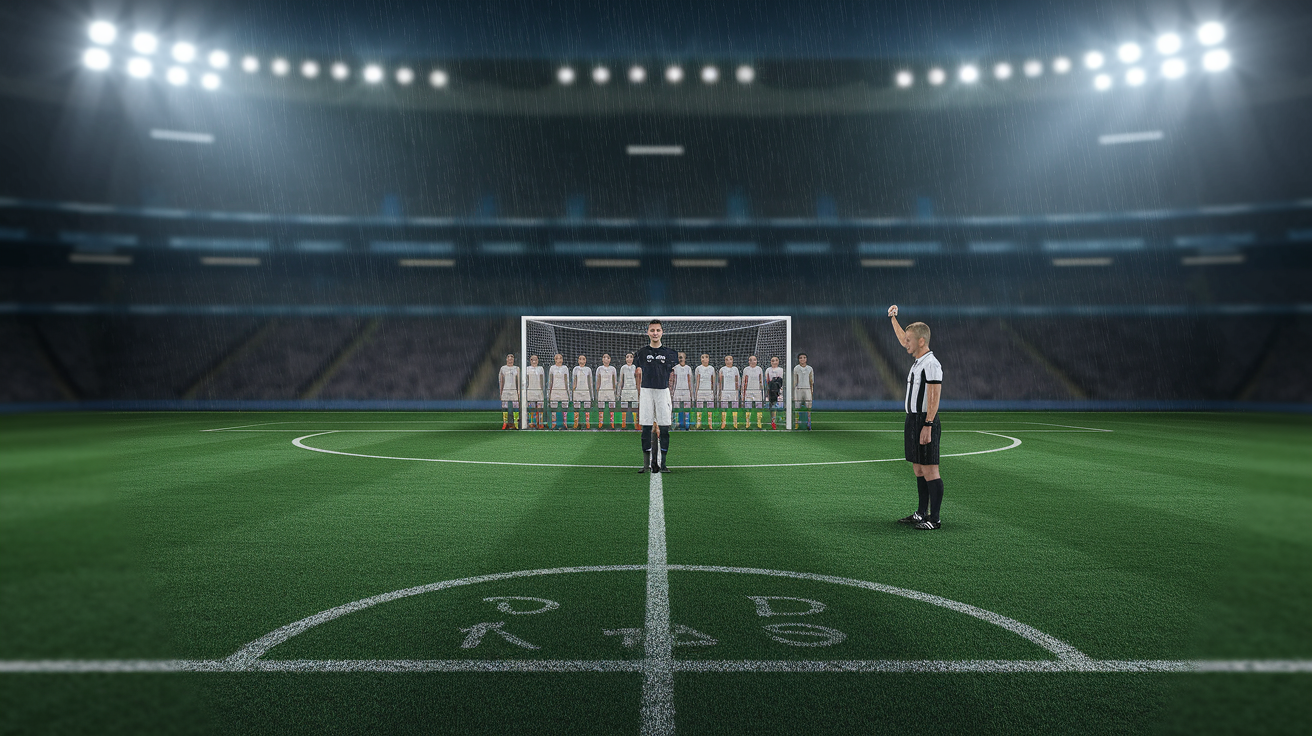
Penalty shootouts only happen in knockout competitions when a match is still tied after 90 minutes and two 15-minute extra-time periods. League games don’t use shootouts. They’re settled by points.
Once extra time ends with the score level, the referee starts kicks from the penalty mark. This falls under IFAB Law 10 (Determining the Outcome) and Law 14 (The Penalty Kick). Every kick gets taken from the penalty mark, which sits exactly 12 yards (11.0 m) from the goal line, centered between the touchlines.
Teams alternate in ABAB order. Each side picks five eligible takers. You can only participate if you were on the pitch when extra time ended. If you’re temporarily off for something legitimate like injury treatment, you can still kick. But if you left and didn’t make it back in time, you’re out.
Before the first kick, the referee runs two coin tosses. The first one decides which goal everyone uses. That way both teams deal with the same pitch conditions, wind, sun angles. The second toss, usually won by a captain or team rep, decides who kicks first. In practice, the team that wins this toss almost always chooses to kick first. Historical data backs this up. There’s a modest advantage to going first.
The best-of-five format ends early if one team builds a lead the other can’t catch. Say Team A leads 3–0 after three kicks and Team B only has two attempts left. It’s over. If the score is tied after five kicks each, the shootout goes to sudden death. Teams alternate single kicks until one scores and the other doesn’t.
Before the first kick, the referee runs through a precise sequence:
- Select the goal (safety, surface quality, lighting all matter).
- First coin toss to confirm the goal with team reps.
- Second coin toss to decide who kicks first.
- Confirm only eligible players are on the pitch. Everyone else moves to the technical area.
- All players except the kicker and both goalkeepers stay inside the centre circle.
- Record the names and shirt numbers of each team’s first five takers. Verify they’re actually on the pitch.
Penalty Kick Mechanics and What Constitutes a Legal Attempt
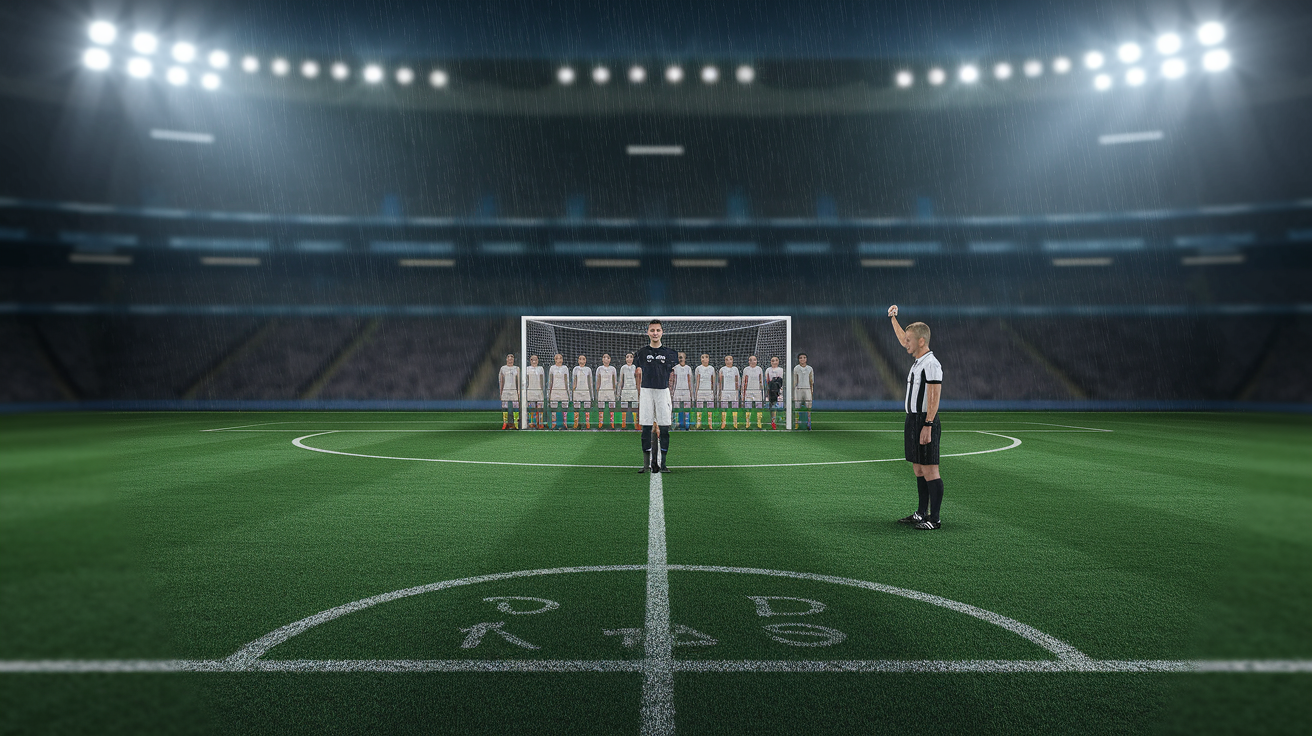
A legal penalty kick needs the taker to strike the ball forward with a single touch. You can feint during the run-up. Change your speed, stutter your steps, adjust your body angle. All allowed. But once your kicking foot starts its final backswing, any feint or deliberate stop counts as unsporting behaviour. That gets you a yellow card and gives the other team an indirect free kick.
The ball has to go forward. You can’t pass it backward or touch it twice. A goal only counts if the ball crosses fully between the posts and entirely below the crossbar as a direct result of that single touch. If the ball bounces off the goalkeeper, a post, or the crossbar and you make contact again before anyone else does, the kick is voided. It’s recorded as missed. A striker once tapped in his own rebound and celebrated, only to watch the referee wave it off because the ball never crossed the line from the original kick.
The goalkeeper has to stay on the goal line, facing you, with at least part of one foot touching the line until you kick the ball. Lateral movement along the line is fine. Lots of keepers use exaggerated arm waving, jumping, or sudden shifts to mess with your head. If the goalkeeper moves off the line too early and you miss or get saved, the referee orders a retake. But if the keeper encroaches and you score, the goal stands.
A common violation: the goalkeeper steps forward just before contact. Assistant referees watch from the goal-line intersection and signal the centre referee if a retake is needed.
Encroachment by outfield players positioned outside the penalty area or inside the centre circle triggers similar rules. Attacker encroaches and the kick scores? Goal disallowed, kick retaken. Attacker encroaches and the kick is saved? No retake. Defender encroaches and the kick is saved? Retake ordered. Defender encroaches and the kick scores? Goal stands. Players who keep encroaching get yellow cards. In shootouts that can lead to send-offs if they pick up a second caution.
| Infringement | Outcome |
|---|---|
| Goalkeeper leaves line early; kick missed | Kick retaken |
| Goalkeeper leaves line early; kick scored | Goal stands |
| Attacker encroaches; kick scored | Kick retaken |
| Defender encroaches; kick saved | Kick retaken |
| Kicker feints after backswing begins | Indirect free kick; yellow card |
Player Eligibility, Order of Takers, and Rotation Rules in Shootouts
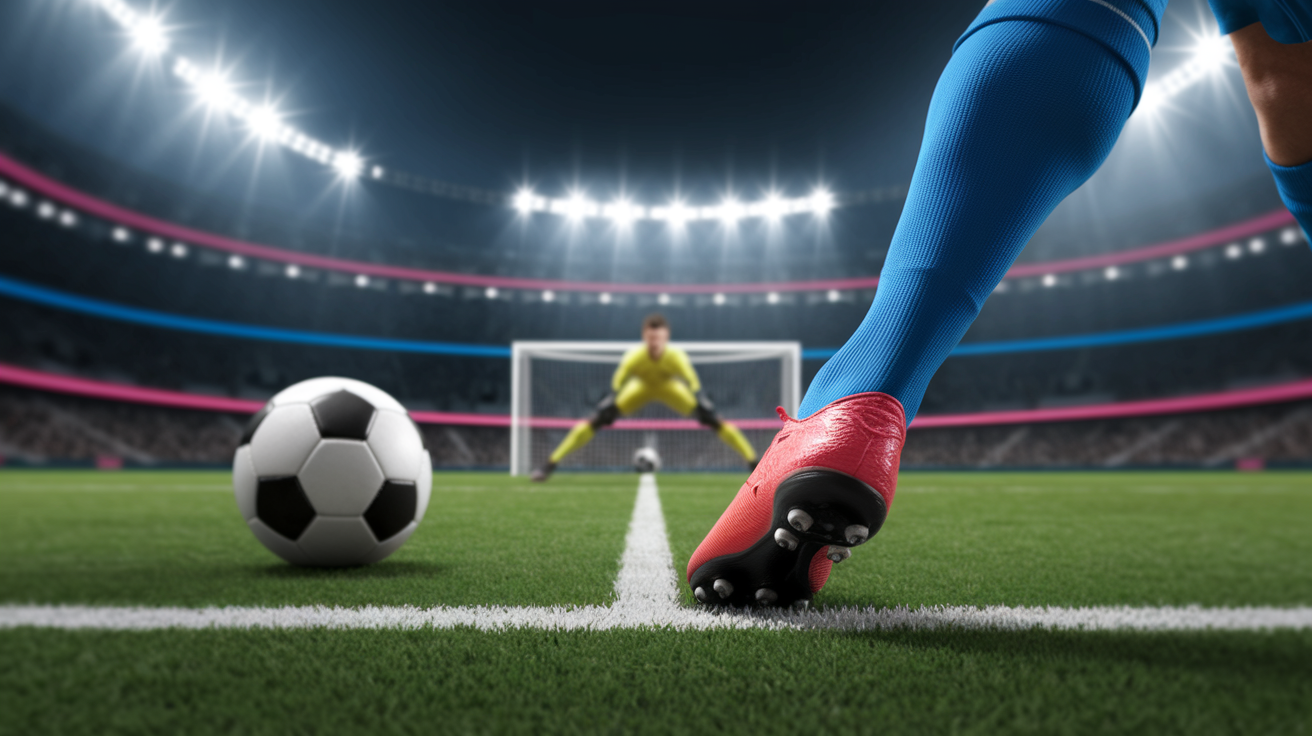
You can only take part in the shootout if you were on the pitch when extra time ended. A player getting treatment off the field at the final whistle can still kick, as long as the injury was legit and they get back before their turn. Players who were subbed out during extra time or left the field without the referee’s permission can’t participate.
Each team has to declare an initial order of five takers, but this list doesn’t need to be handed to the referee beforehand. The referee records names as each kick happens. Goalkeepers can take kicks. Most coaches save them for later rounds if the shootout stretches into sudden death.
No one takes a second kick until every eligible player on that team has taken one. This applies across your full roster of eligible players. If you finish extra time with eleven players, all eleven have to kick before anyone goes again. Once all eligible players have taken a first kick and you’re in sudden death, you can change your kicking order freely. Often teams rotate their strongest takers back to the front.
There’s no formal time limit between kicks, but referees expect you to move promptly once the previous kick is done and the ball is back on the mark. Excessive delay (walking slowly, adjusting your kit repeatedly, obvious gamesmanship) can get you cautioned for timewasting.
Key rotation rules:
- All eligible players (including the goalkeeper) take one kick before anyone repeats.
- You can list any eligible player in any sequence for the first five kicks.
- Kicking order can change once sudden death starts, as long as everyone’s already taken one attempt.
- If a player is absent when called (still getting treatment, for example), that kick is forfeited and recorded as missed. Play continues right away.
Red Cards, Injuries, Unequal Team Sizes, and Special Shootout Situations
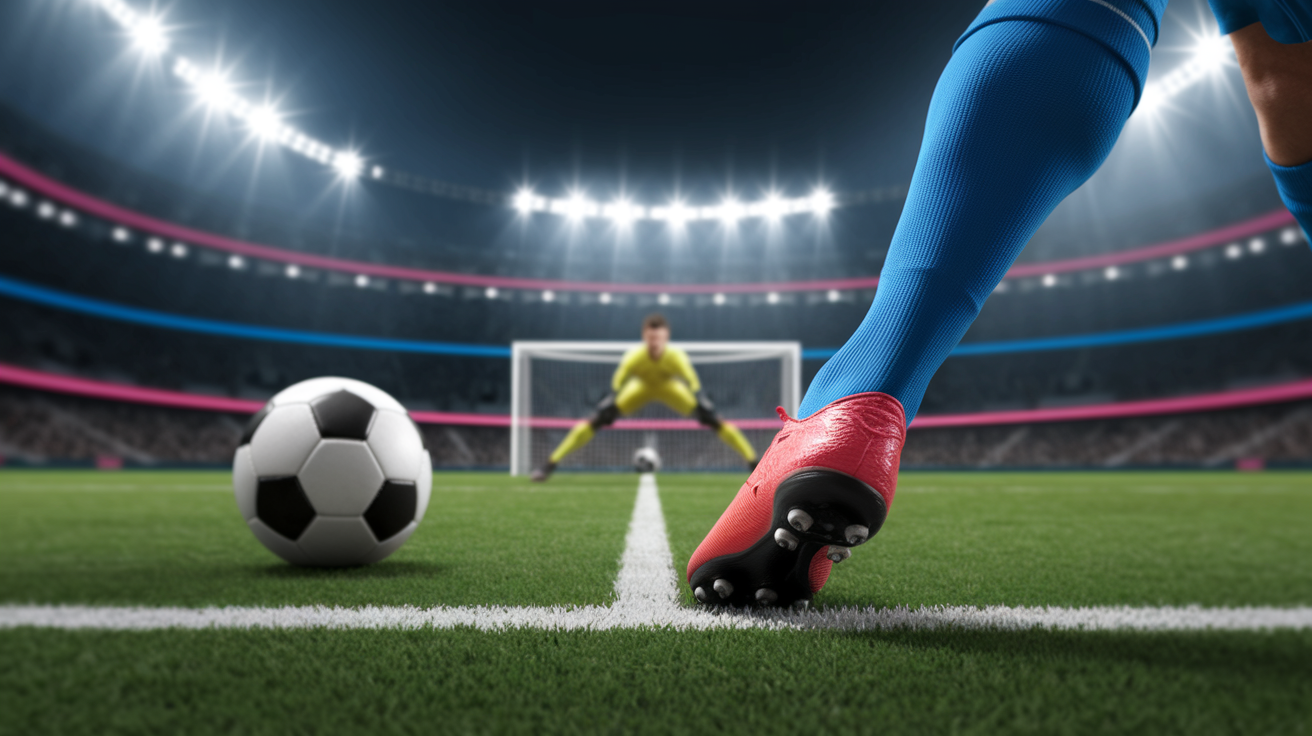
If someone gets sent off during the shootout, you can’t substitute to replace them. The team continues with one fewer kicker. That absent player’s spot in the rotation is forfeited and recorded as a missed kick without a ball being struck. This applies to all outfield players. If a goalkeeper gets sent off during the shootout, another player who finished extra time on the pitch has to take over in goal for the rest of the kicks.
Yellow cards issued during the shootout don’t carry forward to the next match. But a second yellow in the shootout itself becomes a red card and you’re immediately removed from the procedure.
Injuries during the shootout create similar headaches. An injured goalkeeper can be replaced by a substitute only if you haven’t already used all your allotted subs under the competition rules. If all subs are gone, an outfield player takes over in goal. Injured outfield players can’t be substituted during the shootout. If you can’t continue, your scheduled kick is forfeited. The shootout doesn’t pause for lengthy treatment. The referee expects you to be ready when your turn comes or forfeit the attempt.
When one team enters the shootout with fewer players because of a red card during extra time, the other team has to use the “reduce to equate” rule, introduced by IFAB in February 2000. The team with more players selects enough players to sit out, matching the opponent’s reduced roster. For instance, if Team A has eleven eligible players and Team B has ten, Team A’s captain picks one player who won’t participate at all during the shootout. Deselected outfield players move to the technical area. A deselected goalkeeper can’t be removed from goalkeeping duties.
If more players get sent off or injured during the shootout itself, the other team doesn’t reduce further. The original equalization stands. A match can’t be abandoned just because a team drops below seven players during the shootout. The procedure continues to completion.
Special-case outcomes:
- Goalkeeper sent off: Another eligible player becomes goalkeeper. No substitution allowed.
- Outfield player sent off: Kick forfeited. Team continues with fewer takers.
- Goalkeeper injured with subs remaining: Substitute goalkeeper enters. Competition substitution rules apply.
- Outfield player injured: No substitution. Kick forfeited if unable to take.
- Unequal teams at start: Fuller team selects players to sit out, matching opponent’s count exactly.
Sudden Death and Early Termination Rules in Penalty Shootouts
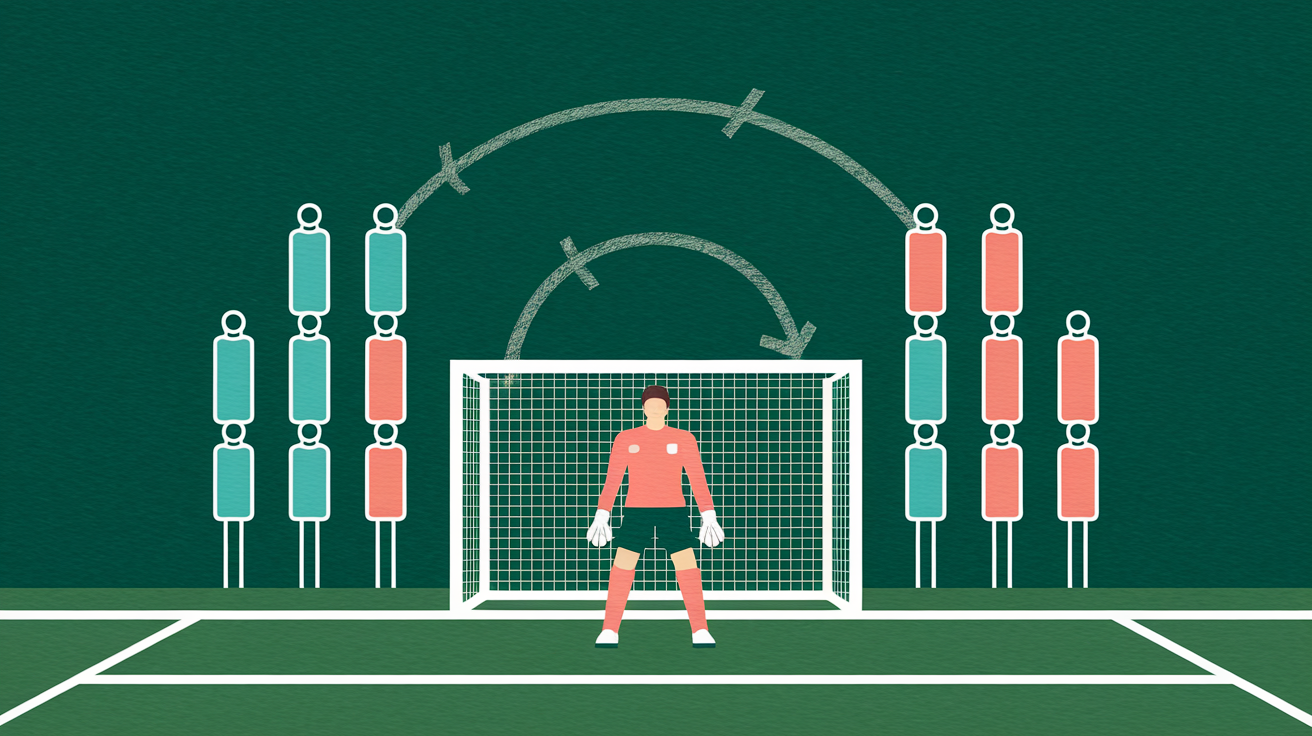
A shootout ends before all five kicks are done if one team gets a lead the other can’t mathematically overcome with their remaining attempts. Say Team A leads 3–1 after four kicks each. Team A only needs one more successful kick to secure a 4–1 advantage with Team B having just one attempt left. If Team A’s fifth kicker scores, the shootout stops right there at 4–1. Team B’s fifth player never gets to kick.
This early termination logic applies at every stage. If after three kicks Team A leads 3–0, the referee ends it because Team B’s maximum possible total (2 successful kicks from 2 remaining attempts) can’t match 3. The 2006 FIFA World Cup final between Italy and France ended on Italy’s fifth successful kick, which put them at 5 goals while France had scored 3 with only one attempt remaining. Fabio Grosso converted, and the whistle blew before David Trezeguet’s teammate could even tie his laces.
If both teams are level after five kicks each, the shootout enters sudden death. Each team sends one kicker at a time in alternating order (Team A, then Team B, then Team A again) until one team scores and the other doesn’t in the same round. The first such mismatch decides the match. There’s no pre-set limit to the number of sudden-death rounds.
Teams keep using eligible players who haven’t taken a kick yet until all have kicked once. Only then can players repeat. The kicking order can be changed freely once sudden death begins, letting coaches rotate their most reliable takers back to the front of the sequence.
Official scoreboards display the shootout result in the format “1–1 (4–3),” where the first pair of numbers is the match score after extra time and the numbers in parentheses are the shootout score.
Sudden-death protocol:
- Teams alternate single kicks, one per side per round.
- The first round in which one team scores and the other misses ends the shootout immediately.
- All eligible players take one kick before any player repeats.
- Kicking order can be revised once sudden death starts, but every player still rotates through once before repeats are allowed.
Referee and Assistant Referee Responsibilities During a Shootout
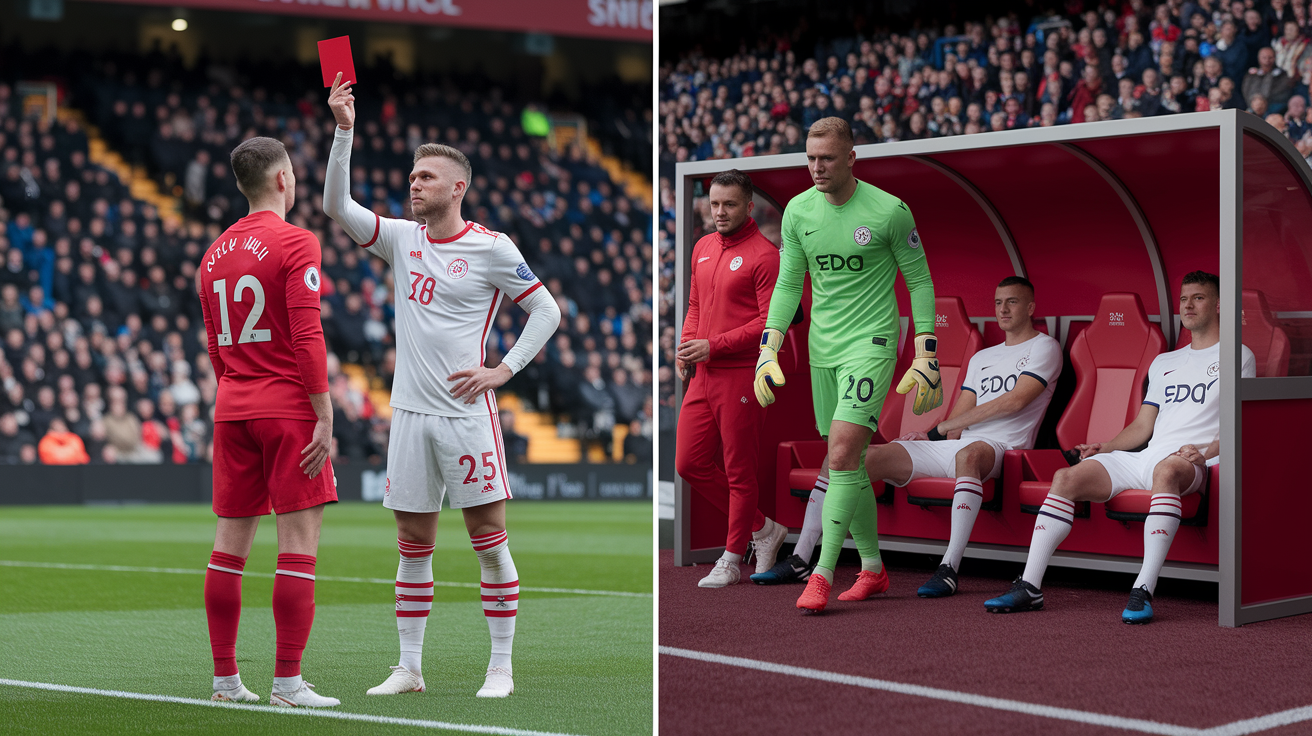
The referee picks the goal where all kicks will be taken, prioritizing safety, surface condition, and adequate lighting. Once the goal is chosen, the referee runs the two coin tosses with designated reps from each team (typically the captains or players who finished extra time on the pitch). The first toss confirms the goal choice (though in practice the referee’s initial selection stands unless someone objects). The second determines which team kicks first.
Throughout the shootout, the referee keeps an official written record of every kick. Kicker’s name, shirt number, outcome (goal, miss, or saved), and any infringements requiring retakes all get noted. Before each kick, the referee makes sure the ball is properly placed on the penalty mark, verifies that only the designated kicker and the two goalkeepers are outside the centre circle, and signals the kicker to go.
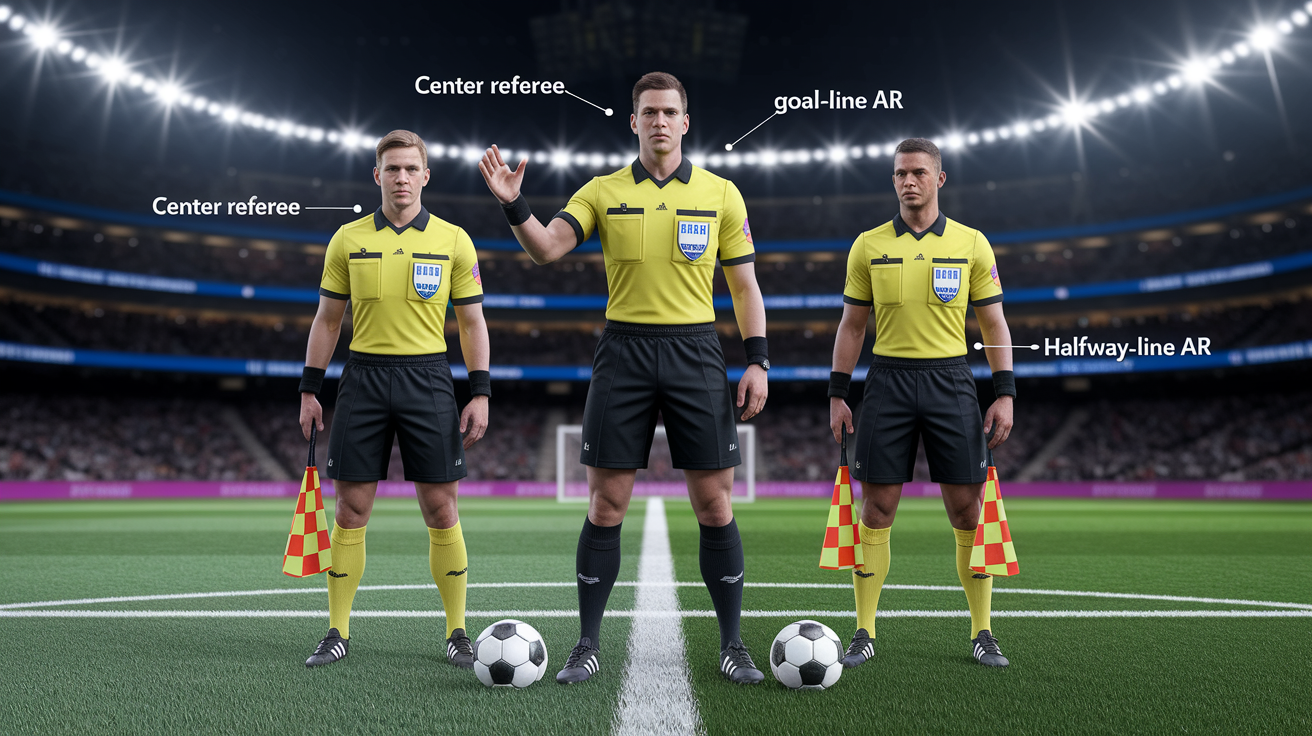
The assistant referee positioned at the goal line–penalty area intersection monitors the goalkeeper’s movement. They watch for premature steps off the line or forward motion before the ball is struck. If something’s wrong, the assistant raises a flag to alert the centre referee, who then decides whether to order a retake based on whether the kick was successful.
The second assistant referee stays at the halfway line, making sure all other players remain inside the centre circle and don’t encroach toward the penalty area. If encroachment happens, that assistant signals the referee, who applies the appropriate sanction.
After each kick, the referee records the result and signals the next kicker forward, keeping a steady rhythm to prevent gamesmanship or delay.
Officials use a small set of standardized signals: a pointed arm toward the kicker to authorize the kick, a horizontal wave for a retake, a finger pointing to the centre circle to instruct players to return, and the final whistle to end the shootout once a result is determined. Referees often keep a small card or notepad to track attempts in real time, cross-referencing shirt numbers with the team sheet to confirm eligibility and avoid confusion in sudden-death rounds when order can change.
| Official | Responsibility |
|---|---|
| Centre referee | Conducts coin tosses, records all kicks, enforces Law 14, signals start and completion |
| Assistant referee (goal line) | Monitors goalkeeper movement, signals infringements, confirms when ball crosses line |
| Assistant referee (halfway line) | Ensures players remain in centre circle, identifies encroachment by non-kickers |
| Fourth official | Manages technical areas, assists with substitution paperwork if goalkeeper is replaced |
| Video assistant referee (where used) | Reviews unclear outcomes (ball crossing line, serious infringements), advises referee |
Alternative Formats and Historical Rule Changes in Shootout Procedures

Between 2017 and 2019, several competitions tried an ABBA kicking sequence designed to cut the advantage enjoyed by the team kicking first. Under ABBA, Team A takes the first kick, then Team B takes two straight kicks, followed by Team A taking two, and so on (A-BB-AA-BB-A).
Research presented to IFAB showed that under the traditional ABAB format, the team kicking first won about 60% of shootouts, a statistically significant edge thought to come from psychological pressure on the second-kicking team. The ABBA format got used in the 2017 FIFA U-17 World Cup, the 2017 UEFA European Under-21 Championship, and England’s EFL Cup (Carabao Cup) for the 2017–18 season.
FIFA didn’t adopt ABBA for the 2018 World Cup. Competitions reverted to ABAB from the 2018–19 season onward after feedback showed that ABBA introduced confusion without really changing outcomes.
Three major IFAB rule changes have shaped modern shootout procedures. In February 2000, the “reduce to equate” rule was introduced to get rid of the advantage a team with more players might have when an opponent had someone sent off in extra time. Before this change, the fuller team could use all its players while the reduced team rotated fewer kickers.
The 2016 Laws of the Game clarified that if a goalkeeper or outfield player is sent off or injured during the shootout itself, the other team doesn’t reduce further. That closed a loophole that had occasionally been exploited.
Most recently, IFAB Circular No. 31, issued in 2025, addressed accidental double-touches during penalty kicks. If a kicker makes unintentional secondary contact with the ball (after a slip or a bobbled plant foot), the referee orders a retake rather than disallowing the goal. This clarification came after cases in the 2022 Women’s European Championship final (Beth Mead) and later club matches.
Timeline of rule changes:
- 1986: Rebound clarification introduced after controversy. Only the initial kick can produce a goal.
- February 2000: “Reduce to equate” rule prevents numerical advantage for fuller team.
- 2016: Further clarification that teams don’t reduce again if opponent loses a player during shootout.
- 2025: IFAB Circular No. 31 standardizes retake procedure for accidental double-touch by kicker.
Tactical, Psychological, and Coaching Strategies for Penalty Shootouts
Selecting the five primary takers and the next six players in sudden-death order is the foundation of shootout prep. Coaches rank players 1 through 11 based on penalty-taking ability, mental composure under pressure, and likelihood of staying on the pitch at the end of extra time.
The fifth kicker often carries special weight. Teams frequently save their most reliable taker for this slot because in a close shootout, the fifth kick can be decisive in a 4–3 or 5–4 outcome. But this is tactical rather than mandatory. Some coaches prefer to put their best taker first to grab early momentum. Others spread strong takers throughout the sequence to avoid a weak link at any position.
Mental prep is as important as technical skill. Players benefit from visualization exercises where they mentally rehearse the entire kick sequence: walking to the mark, selecting a target zone, executing the strike, reacting to the outcome. Pressure management techniques include controlled breathing routines, pre-kick rituals (adjusting the ball, wiping hands, a quick glance at the target), and focusing on process rather than result.
Coaches stress that no single kick wins or loses the shootout. That reduces the psychological burden on each taker. For players who get anxious, practicing kicks in front of teammates or with simulated crowd noise can desensitize them to the intensity of a real shootout. One club manager had his squad practice penalties while the reserve team jeered and banged drums behind the goal, replicating a hostile away crowd.
Goalkeepers get specialized training focused on reading body language, analyzing opponent tendencies, and staying mentally independent from the scoreboard. Coaches review footage of opposing kickers’ previous penalties, noting preferred target zones, run-up patterns, and any tells like hip angle or plant-foot position.
During the shootout, keepers get reminded to treat each kick as an isolated event, ignoring the cumulative score and avoiding the trap of feeling responsible for the outcome. Some coaches train keepers to use gamesmanship within the rules: delaying slightly before positioning, adjusting gloves, or making eye contact with the kicker to introduce doubt.
Goalkeepers also get drilled on the retake scenario. If a save keeps the ball in play and a whistle orders a retake for encroachment, you have to reset emotionally and prepare to face the same kicker again.
Coaching priorities:
- Identify five primary takers and rank the next six players for sudden-death rounds based on ability and composure.
- Decide whether to place the best taker first, fifth, or distributed. Align strategy with team psychology.
- Practice the complete shootout process, including coin toss simulation, player positioning, and timed kick intervals.
- Use visualization, breathing routines, and pre-kick rituals to manage pressure and build confidence.
- Train goalkeepers to analyze opponent footage, read body language, and reset mentally after each kick.
- Simulate high-pressure scenarios in training: hostile noise, sudden-death situations, retake procedures. Desensitize players.
Famous Penalty Shootout Examples and What They Teach About the Rules
The 2006 FIFA World Cup final between Italy and France is a textbook case of early termination. With the score level after extra time, Italy and France went to a shootout. After each team had taken four kicks, Italy led 4–3. Fabio Grosso stepped up for Italy’s fifth attempt and scored, giving Italy a 5–3 lead.
Because France had only one kick remaining and could at best reach 4 goals, the referee ended the shootout immediately without letting France’s fifth kicker attempt. This example clarifies the mathematical principle: a shootout ends the instant one team’s lead becomes insurmountable, not after a full round of five kicks per side.
An earlier incident from the 1986 FIFA World Cup highlighted the single-touch rule and rebound clarification. A striker in that tournament took a penalty, saw the ball rebound off the post, and scored from the rebound before anyone else touched it. The goal was initially allowed but later reviewed, prompting IFAB to issue a clarification: only the ball’s initial trajectory from a single kick can result in a goal. Later touches by the same kicker void the attempt.
This ruling is still in force and occasionally gets tested when a kicker’s plant foot accidentally nudges the ball a second time after the strike, triggering a retake under IFAB Circular No. 31 (2025).
Domestic cup competitions have occasionally experimented with variations. The EFL Cup (Carabao Cup) in England used the ABBA format for one season (2017–18) before reverting to ABAB. Though designed to level the playing field, coaches and players reported confusion over the alternating-pair sequence. Statistical analysis showed no significant fairness improvement.
The reversion underscored the principle that procedural simplicity and universal consistency often outweigh theoretical fairness gains, especially when the advantage margin is modest.
| Match | Rule Highlighted | Lesson |
|---|---|---|
| 2006 World Cup final (Italy–France) | Early termination | Shootout ends immediately when lead becomes mathematically unassailable |
| 1986 World Cup incident | Rebound and single-touch rule | Only the ball’s initial trajectory from one kick can produce a goal; kicker may not touch again |
| 2017–18 EFL Cup (ABBA trial) | Alternative kicking sequence | Complexity and marginal fairness gains led to reversion to traditional ABAB format |
Final Words
In the action, we mapped when matches head to kicks and why extra time matters.
You got the IFAB checklist: coin toss, eligible players, ABAB best-of-five, sudden death, and referee steps, plus special cases and keeper/taker tactics.
This wraps up the penalty shootout rules and procedures explained, with clear steps refs follow and quick takeaways for coaches and fantasy players. You’ll feel ready and confident next time a match comes down to the 12-yard mark.
FAQ
Q: What are penalty shootout rules?
A: The penalty shootout rules explain tied matches go to kicks from the 12‑yard mark after extra time, use ABAB best‑of‑five with coin toss deciding goal and order, only on‑field players eligible; sudden death follows if tied.
Q: Can a keeper touch the ball twice in a penalty shootout?
A: The keeper cannot legally touch the ball twice on one shootout attempt; the kick is single‑touch and rebounds off the keeper are dead, so no extra touches or follow‑plays count for that attempt.
Q: What if no one scores in a penalty shootout?
A: If no one scores after the initial five kicks each, the shootout moves to sudden death: teams alternate single kicks until one team scores and the other misses, producing a winner.
Q: Can you switch goalies before a penalty kick?
A: You can switch goalkeepers only if your team has a substitution remaining and completes it; otherwise no. Only players who were on the field at the end of extra time may take part in the shootout.