


Think an ankle sprain is just a few missed minutes? It can flip a supposed win overnight.
When a key player sits, spreads often move 4 to 8 points and win probability can drop double digits.
This post shows how injuries change offensive and defensive ratings, pace, and net rating, and how those stat moves immediately reshape spreads, moneylines, and real game outcomes.
Read on for the stats, the injury types that matter most, and the betting and fantasy angles that follow.
Immediate Statistical Effects of NBA Injuries on Game Outcomes and Win Probability

When a key player goes down, the numbers move fast. Star absences usually shift point spreads by 4 to 8 points. Starters move lines 2 to 4 points. Rotation guys? Somewhere between half a point and 2.
These aren’t random guesses. Sportsbooks dig into how the team performed without that player historically, check what the backup can actually do, and figure out how the matchup changes. A team winning 60% of its games with the starting point guard might drop to 42% without him. That’s an 18 point swing in win probability, and it shows up immediately in the spread and moneyline.
Offensive rating, defensive rating, pace, net rating. All of it shifts when the rotation changes, and those shifts tell you the new expected score and win likelihood.
The gap between what people expect and what actually happens? It widens fastest in the first few hours after the news breaks. Teams missing their main offensive initiator see offensive rating fall by 3 to 5 points per 100 possessions on average. Lose a rim protector and opponent offensive rating climbs by about the same amount. Net rating, the difference between what you score and what you allow, often swings 5 to 10 points depending on who’s out. That delta is the best single predictor of how much win probability drops.
Pace matters too. Losing a transition playmaker slows things down, which means fewer total possessions and lower expected scoring for both teams.
The game stats most affected:
- Offensive rating: points per 100 possessions, drops hard when primary scorers or playmakers miss time.
- Defensive rating: points allowed per 100, rises when elite defenders or rim protectors sit.
- Pace: possessions per 48, decreases when floor generals or transition threats aren’t available.
- Net rating: offensive minus defensive rating, the single stat that correlates tightest with win probability.
Sportsbooks turn these shifts into new win probabilities using regression models trained on thousands of past games. They pull splits showing team performance with and without the injured guy, compare what the backup brings, adjust for opponent strength and schedule context. Analysts do something similar, adding lineup plus-minus data and position impact estimates to forecast the new point differential. The result? A new spread, moneyline, and total that reflect changed win probability. How fast and accurate those adjustments are determines where betting value shows up.
How Specific Injury Types Alter NBA Team Performance Metrics

Not every injury hits the same. A torn ACL that ends a star’s season creates immediate chaos and forces long term roster moves. A minor ankle sprain might cost a game or two with barely any ripple effect.
Broken bones and torn ligaments, especially knees, ankles, shoulders, take players out for weeks or months and eliminate consistent role execution. Muscle strains and soft tissue stuff tied to fatigue tend to be shorter but often come back, creating unpredictable availability and forcing coaches to manage minutes restrictions that destabilize rotations.
The body part matters as much as the diagnosis. A hand or wrist injury kills shooting accuracy and ball handling for guards. A shoulder injury reduces shooting range and on ball defense.
Knee and ankle injuries disrupt game outcomes most because they limit explosiveness, lateral quickness, vertical leap. Skills that underpin both sides of the ball. A sprained ankle might drop a wing defender’s contest rate and allow easier opponent drives, raising defensive rating 2 to 3 points per 100 possessions. A partial MCL tear costing a primary scorer five games often matches up with a 4 to 6 point drop in offensive rating during that stretch, especially if the backup can’t replicate shot creation or floor spacing.
Hand and wrist injuries hit shooters hardest. A fractured finger can drop three point percentage 5 to 8 points and force the injured player into facilitator only mode, changing offensive balance and creating predictable defensive adjustments from opponents.
Younger players generally recover faster and return closer to baseline. Veterans over 32 often see lingering effects: reduced minutes, slower lateral movement, lower usage rates even after medical clearance. Timing within the season shapes outcomes too. An early absence allows time for lineup experimentation and chemistry rebuilding. A late season or playoff injury leaves little room for adjustment and magnifies performance losses.
The biggest statistical changes by injury type:
- Torn ligaments (ACL, MCL): sharp defensive rating, pace, and net rating drops; multi month absences force permanent rotation shifts.
- Muscle strains (hamstring, calf, groin): moderate offensive rating declines and recurrence risk that creates game to game availability uncertainty.
- Bone fractures (hand, foot, wrist): severe shooting accuracy drops and ball handling limitations; defensive rating rises if the injury sidelines a primary defender.
Historical Trends: How Injuries Have Shifted NBA Outcomes Across Seasons

League wide injury data from 1951 to 2023 shows both frequency and severity climbing over time. Season ending injuries among All Stars have risen notably since the mid 2000s.
Statistical analysis of injury related win probability shifts reveals teams historically lose 0.8 to 1.2 win shares per 10 games when a star is absent. Those losses concentrate in close games where the missing player’s clutch scoring or defensive stops would’ve tipped outcomes. Injury driven upsets, games where heavy favorites lose after late breaking injury news, cluster around playoff races and nationally televised matchups. Sportsbook lines move quickly but bettors sometimes lag behind the new reality.
Survival analysis models trained on decades of player season data confirm injury risk has increased significantly in recent years. The “season” variable shows a statistically significant upward trend (p = 0.02). This pattern holds even after controlling for player age, minutes load, and position, suggesting modern playing style, faster pace, more three point attempts, increased defensive switching, may elevate injury exposure.
Teams that historically performed well without specific stars tend to have deep benches, flexible coaching schemes, multiple playmakers. Squads built around a single offensive hub see win percentages crater when that player goes down.
| Season | Win Shares Lost | Notable Impacted Team |
|---|---|---|
| 2018–19 | 12.4 | Golden State Warriors (Durant, Cousins absences) |
| 2019–20 | 15.1 | Brooklyn Nets (Irving, Durant long-term injuries) |
| 2021–22 | 10.8 | LA Clippers (Leonard season-ending ACL recovery) |
| 2023–24 | 13.6 | Phoenix Suns (Durant, Beal combined absences) |
The pattern across these seasons stays consistent. Teams lose more games than pre injury win probability models predicted, and the gap widens when injuries strike primary ball handlers or elite defenders. Multi injury seasons compound the effect. Losing two starters simultaneously can double the expected win share loss rather than simply adding individual impacts. Historical upset frequency also rises when favorites lose stars within 24 hours of tip off, creating market inefficiencies that sharp bettors exploit by fading public money that hasn’t yet adjusted to the new roster reality.
Case Studies: Star Absences and Their Direct Influence on NBA Game Results
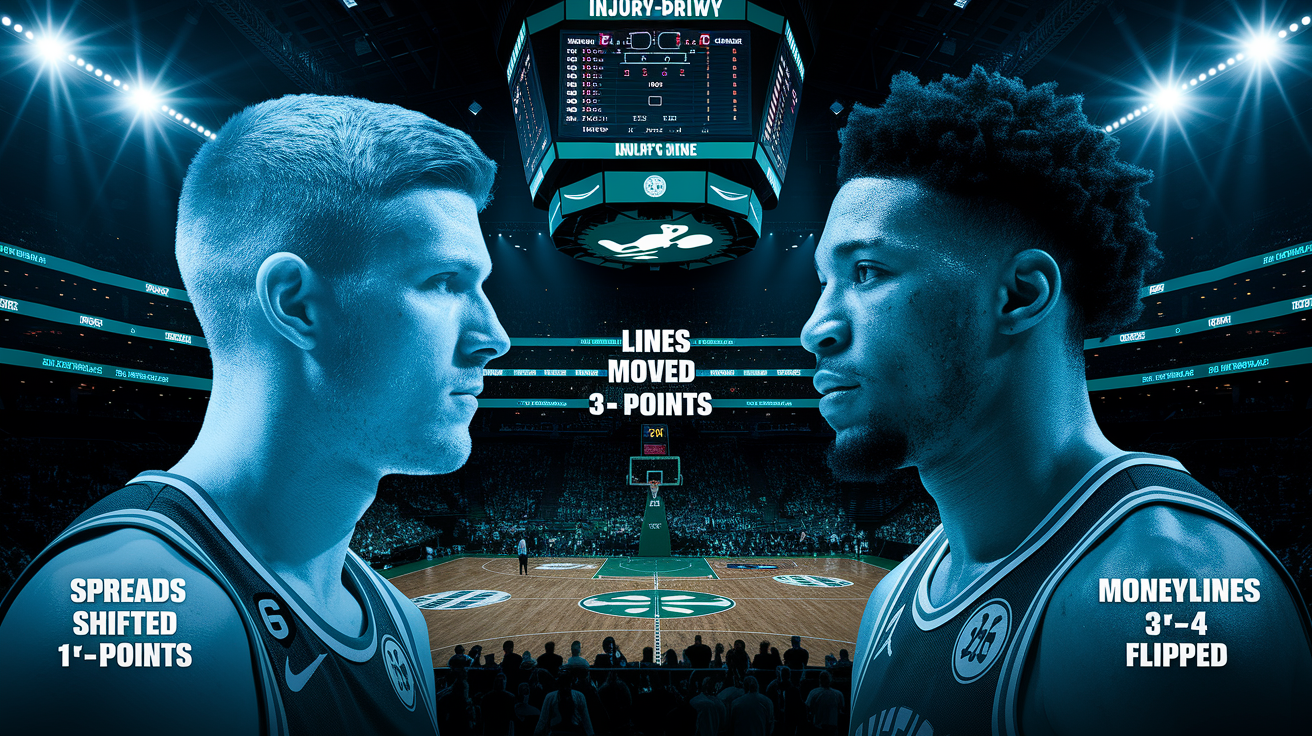
Kristaps Porziņģis’ injury during the 2024 season shows how severity and timeline shape outcomes. Early reports listed him as day to day, and sportsbooks made only modest line adjustments. Spreads shifted 1 to 2 points, totals largely unchanged.
As imaging confirmed a multi week absence, lines moved another 3 to 4 points. Moneylines flipped in several upcoming games. Totals dropped 4 to 6 points to reflect both his lost scoring and the Celtics’ reduced pace without a stretch five spacing the floor. The team’s net rating fell by 8.2 points per 100 possessions during his absence. They failed to cover the spread in 62% of games over that stretch, well above their season average.
Jaylen Brown’s absence in a different 2024 contest shows the immediate impact of losing a two way star. Before the injury announcement, Boston was a 7.5 point favorite. Within 90 minutes, the line had moved to 4.5. By tip off it sat at 3.
The Celtics’ offensive rating in that game dropped 6 points compared to their season average. Their defensive rating rose 3 points because Brown’s primary defensive assignment, a high usage opponent wing, went off for 12 points above his season average. The final margin was a 2 point loss. The original spread would’ve been a loss for Boston backers, but the adjusted line still didn’t fully capture the two way impact.
Mid 2010s cases involving stars like Stephen Curry and LeBron James reveal similar patterns. When Curry missed playoff games with ankle issues, Golden State’s offensive rating fell by an average of 9.4 points per 100 possessions across the sample. Their pace dropped by 2.1 possessions per game. Win probability in those contests averaged 38% compared to 72% with him healthy.
LeBron’s absences during Cleveland’s title runs showed even starker splits. The Cavaliers posted a negative 11.3 net rating without him in the 2016 and 2017 playoffs. Their assist rate fell 7 percentage points, forcing iso heavy offense that opponents defended more effectively.
According to Top 5 Ways Player Injuries Affect NBA Betting Lines, point spreads moved an average of 6.2 points when MVPs or All NBA first teamers were ruled out within 24 hours of game time. The early information window, typically the first 60 to 90 minutes after news broke, offered the sharpest value because public betting patterns lagged sportsbook adjustments.
Typical statistical effects observed across star absence case studies:
- Net rating drop: average decline of 7 to 12 points per 100 possessions when an All Star misses a game.
- Assist rate decline: 4 to 8 percentage point drop when the primary playmaker is unavailable.
- Defensive efficiency loss: opponent offensive rating rises 3 to 5 points when an elite perimeter or rim defender is out.
- Turnover increases: team turnover rate climbs 1 to 3 percentage points as backup ball handlers face higher usage.
- Pace changes: possessions per 48 minutes fall by 1 to 3 when floor generals or transition stars are sidelined.
How Lineup Disruptions and Rotation Changes Shape NBA Outcomes

Losing a starting point guard doesn’t just remove one player’s production. It forces the backup into higher usage, shifts ball handling responsibilities to wings or centers who aren’t natural facilitators, and disrupts the team’s offensive sets and defensive communication.
These ripple effects show up as lower offensive efficiency, slower pace, higher turnover rates. Teams with deep benches and multiple playmakers absorb the loss more gracefully, often replacing 70 to 80% of the missing player’s impact through committee contributions. Squads built around a single offensive hub see sharper declines. Net rating dropping 8 to 12 points per 100 possessions, win probability falling 15 to 25 percentage points in tough matchups.
Coaching adjustments determine how quickly and effectively a team adapts. Flexible coaches shift defensive schemes. Moving from aggressive trapping to conservative drop coverage when a mobile big is injured, for example. They redistribute offensive touches to keep the system functional.
Less adaptable staffs stick to the original game plan even when personnel can’t execute it, leading to predictable opponent counters and compounding performance losses. Overworking backups during condensed schedules or back to backs creates measurable inefficiencies. Fatigue related shooting declines, slower rotations, higher foul rates all appear in the data when reserves log 8 to 12 extra minutes per game over multiple consecutive nights.
| Lost Starter | Primary Replacement | Expected Outcome Change |
|---|---|---|
| Starting point guard | Backup PG or combo guard | Offensive rating –4 to –6, pace –1.5 to –2.5, assist rate –5 to –8 percentage points |
| Dominant center | Backup C or small-ball lineup | Defensive rating +3 to +5, opponent FG% at rim +6 to +9 percentage points, rebounding rate –4 to –7 percentage points |
| Two-way wing | Role-player wing or position-less lineup | Net rating –3 to –6, opponent primary scorer usage +4 to +7 percentage points, team three-point rate –2 to –4 percentage points |
Lineup chemistry and pace effects magnify when multiple players are out simultaneously. A team missing both its starting point guard and center loses offensive initiation and rim protection at once. Forces the backup point guard to operate without a reliable pick and roll partner, leaves the defense vulnerable to both penetration and post ups.
These compounded disruptions can swing net rating 10 to 15 points and turn a playoff caliber squad into a lottery level performer for the duration of the absences. Pace typically falls because backup heavy lineups play more cautiously, run fewer transition opportunities, take longer to execute half court sets. All of which lowers total possessions and expected scoring for both teams.
Predictive Metrics and Models That Forecast NBA Outcomes After Injuries

Analysts and sportsbooks rely on historical performance splits to estimate how a team will perform without a specific player. The simplest approach pulls all games from the past two seasons in which the player was absent and calculates the team’s offensive rating, defensive rating, net rating, and win percentage across that sample.
More sophisticated models adjust for opponent strength, rest days, home court advantage, then apply regression techniques to isolate the player’s individual contribution. Position specific metrics, a point guard’s assist rate, a center’s contested shot percentage, a wing’s defensive versatility score, help quantify how much of the player’s impact can be replicated by the backup versus how much is truly irreplaceable.
Simulation models take these historical splits and run thousands of game simulations using Monte Carlo methods. Varying opponent performance within realistic ranges, adjusting for lineup combinations the team is likely to deploy. Each simulation produces a projected final score and win probability. The distribution of outcomes reveals both the most likely result and the range of uncertainty.
Machine learning models, often gradient boosted trees or neural networks, train on play by play data to predict possession level outcomes, then aggregate those predictions into full game forecasts. These models can incorporate real time injury updates, lineup announcements, even in game substitutions to continuously update win probability as new information arrives.
Injury adjusted Elo ratings and similar ranking systems update team strength in real time by applying a penalty proportional to the injured player’s estimated win share contribution. A team might enter a game with an Elo rating of 1620, but losing a star worth plus 8 wins per season could reduce the rating to 1580 for that contest, shifting expected win probability and corresponding point spread.
Small sample sizes create challenges. If a star has only missed five games in the past two years, the historical split might not be statistically reliable. Forces analysts to rely on proxy metrics such as on off splits from lineup data or comparisons to similar players’ injury impact patterns from other teams.
The most widely used predictive stats for injury adjusted forecasts:
- Offensive rating splits: team points per 100 possessions with and without the injured player, adjusted for opponent defensive strength.
- Defensive rating splits: points allowed per 100 possessions with and without the player, adjusted for opponent offensive strength.
- Net rating delta: the difference between the team’s net rating with the player on the court versus off the court, often the cleanest single number summary of impact.
- Lineup plus minus data: plus minus performance of specific five man units that include or exclude the injured player, revealing which lineup combinations can partially compensate for the loss.
Injuries and NBA Betting Outcomes: How Line Movements Reflect Expected Game Results

Point spreads react within minutes of verified injury news. Sportsbooks adjust lines based on internal models that estimate win probability changes, then monitor early betting volume to gauge whether the new line accurately reflects public and sharp perception.
A star absence that should move a spread by 6 points might initially shift only 4 points if the book wants to test market reaction, then jump the final 2 points once heavy money comes in on the opponent. The first hour after injury news offers the sharpest value because recreational bettors often haven’t yet seen the update. Professional bettors and algorithms pounce immediately, creating temporary line inefficiencies before the market fully corrects.
Totals, over under, adjust based on whether the injured player is primarily a scorer or a defender. Losing a 25 point per game scorer typically drops the total 3 to 6 points. Losing an elite rim protector can raise the total 2 to 4 points as the opponent’s expected scoring increases.
Two way players produce mixed effects. If the offensive loss outweighs the defensive gain, the total falls. If the defensive drop is larger, the total rises. Multiple injuries compound these movements. Losing both a primary scorer and a defensive anchor might leave the total unchanged because the effects offset, or it might move dramatically in one direction if one impact dominates.
Moneyline probability changes translate directly from updated win probability estimates. A team with a 65% win probability before an injury might fall to 48% after losing its best player. That shift moves the moneyline from around negative 186 to roughly plus 108.
Early moneyline value appears when sportsbooks adjust spreads quickly but lag on updating moneylines, or when the market overreacts to a headline injury without fully accounting for the backup’s ability to fill the role. Bettors who track historical without player data and know which backups perform well in spot starts can identify these windows and capture positive expected value.
Major betting effects driven by injuries:
- Point spread shifts: initial moves of 2 to 8 points depending on player importance, with continued adjustments as betting action and additional news, severity, timeline, arrive.
- Totals adjustments: 2 to 6 point moves based on whether the injured player’s primary impact was offensive or defensive, and whether the backup changes expected pace.
- Moneyline probability changes: win probability swings of 10 to 30 percentage points for star absences, reflected in moneyline odds that can flip a favorite to an underdog.
- Timing based inefficiencies: value concentrated in the first 1 to 2 hours post announcement before the market fully incorporates the news; opportunity for arbitrage or middle plays when different sportsbooks adjust at different speeds.
Psychological and Momentum Effects of NBA Injuries on Game Outcomes

High profile injuries, especially those that happen live during a game, trigger immediate psychological and emotional responses from teammates, opponents, and the crowd. When a star goes down with a visible injury, the injured team often experiences a brief rally fueled by urgency and determination. Followed by a performance drop once the adrenaline fades and the roster imbalance becomes clear.
Opponents sometimes ease off defensively or shift focus to exploiting the weakened lineup. That strategic adjustment can accelerate scoring runs and swing game momentum. The psychological toll shows up in hesitation, over helping on defense, rushed offensive possessions as players try to compensate for the missing production.
Comeback probability after losing a starter depends heavily on the score at the time of injury, the remaining minutes, and the bench’s ability to maintain energy and execution. Teams trailing by double digits when a key player exits rarely mount successful comebacks because the roster imbalance compounds the existing deficit.
Squads leading or tied at the injury moment often hold on if the remaining starters can steady the offense and the coaching staff makes quick, effective adjustments. But win probability still drops measurably, often by 15 to 25 percentage points even in close games.
Observable psychological and momentum effects:
- Short term emotional rally: 2 to 4 minute surge immediately after injury as teammates play with heightened focus, often erased once opponents adjust.
- Increased hesitation and over helping: defensive breakdowns as players try to cover for the missing defender, leading to open threes and easy opponent baskets.
- Offensive inconsistency: rushed shot selection and over dribbling as remaining scorers press to fill the scoring void, raising turnover rates and lowering shooting efficiency.
Long-Term Implications: Season Outlook, Playoff Positioning, and Roster Adjustments After Injuries

Multi week or season ending injuries force front offices to evaluate whether the current roster can remain competitive or if trades, buyouts, or G League call ups are necessary to fill the gap. A team in playoff contention that loses its best player for two months must decide whether to stand pat and hope for a return in time for the postseason, or to acquire a veteran replacement and sacrifice future draft capital.
Those decisions shape season outcomes. Teams that aggressively add talent often stabilize their record and maintain playoff positioning. Teams that wait and hope frequently slide in the standings as losses accumulate.
Playoff seeding shifts directly impact long term outcomes because a drop from the 3 seed to the 6 seed changes first round matchups, travel schedules, home court advantage. A single extended injury can cost a team 4 to 6 wins over a two month stretch. In a tight conference that’s the difference between hosting a series and facing a top opponent on the road.
Sportsbook futures markets adjust these probabilities in real time. Championship odds lengthening, playoff berth probabilities falling as injury timelines extend. Analysts model these effects by running season simulations with the injured player’s games missed distributed across the remaining schedule, then calculating how many additional losses are likely and how those losses affect final standings.
Roster construction around injury resilience has become a front office priority. Teams invest in versatile players who can fill multiple positions, maintain deeper benches, use load management to reduce in season injury risk. The trade deadline often sees a flurry of activity when contenders lose stars. Acquiring a replacement scorer or defender can swing playoff odds by 5 to 10 percentage points and justify the cost in future assets.
Return timelines remain uncertain even after players are medically cleared. Minutes restrictions and rust periods create week to week performance volatility that sportsbooks and fantasy managers must account for when setting lines and projections.
Final Words
in the action, injuries shift lines and win chances fast, with star absences moving spreads 4–8 points, starters 2–4, and rotation losses 0.5–2; net rating and win-probability swings follow those changes.
We covered measurable impacts (offensive rating, defensive rating, pace, net rating), injury types, historical trends, lineup and rotation shifts, predictive models, betting effects, and momentum.
Bottom line: understanding how injuries affect nba game outcomes turns guesswork into actionable reads for fantasy and betting, and it keeps the season interesting — teams adjust and backups rise, so stay alert.
FAQ
Q: Why can’t you wear 69 in the NBA?
A: The reason you can’t wear 69 in the NBA is mostly practical: teams and the league avoid that crude number. There’s no universal rule, but image, team policy, and backlash usually block it.
Q: Who are the 4 NBA billionaires?
A: The four NBA billionaires often cited are Steve Ballmer, Mark Cuban, Joe Tsai, and Michael Jordan; valuations shift, and others like LeBron James or Dan Gilbert may join depending on net worth updates.
Q: What are the top 3 safest sports?
A: The top three safest sports are generally swimming, golf, and table tennis — low contact, minimal collision risk, and lower acute-injury rates compared with contact sports like football or hockey.
Q: What happens to your bet if a player gets injured in the NBA?
A: If a player gets injured, your bet’s outcome depends on the wager and sportsbook rules. Team bets usually stand; player props are often voided and refunded if the player doesn’t play or meet minimum-action rules.