


Think a yellow card is just a slap on the wrist?
Not really.
A yellow keeps you on the pitch but puts you on thin ice. A red boots you off and leaves your team a man down.
This quick explainer breaks down exactly what each card means, which fouls earn them, how two yellows turn into a red, and the tactical and suspension ripple effects that follow.
By the end you’ll know how a single booking can change a manager’s plan and tilt a game.
High-Level Comparison of Yellow and Red Cards in Soccer

A yellow card is an official caution. You stay on the pitch, but you’re on thin ice. A red card boots you from the match immediately and drops your team to ten players for however long is left. Get two yellows in the same game? That’s a red. You’re gone.
The difference is straightforward: yellows let you keep playing, reds don’t. Once you’re cautioned, every challenge becomes a calculation. One more booking and you’re walking. A red changes everything the second it’s shown. Your team loses a body, no replacement allowed, and the entire shape of the game shifts.
| Card Type | Core Effect |
|---|---|
| Yellow | Official caution; player remains on the field |
| Red | Immediate send-off; team plays with one fewer player |
Yellow Card Meaning, Offenses, and In-Match Consequences
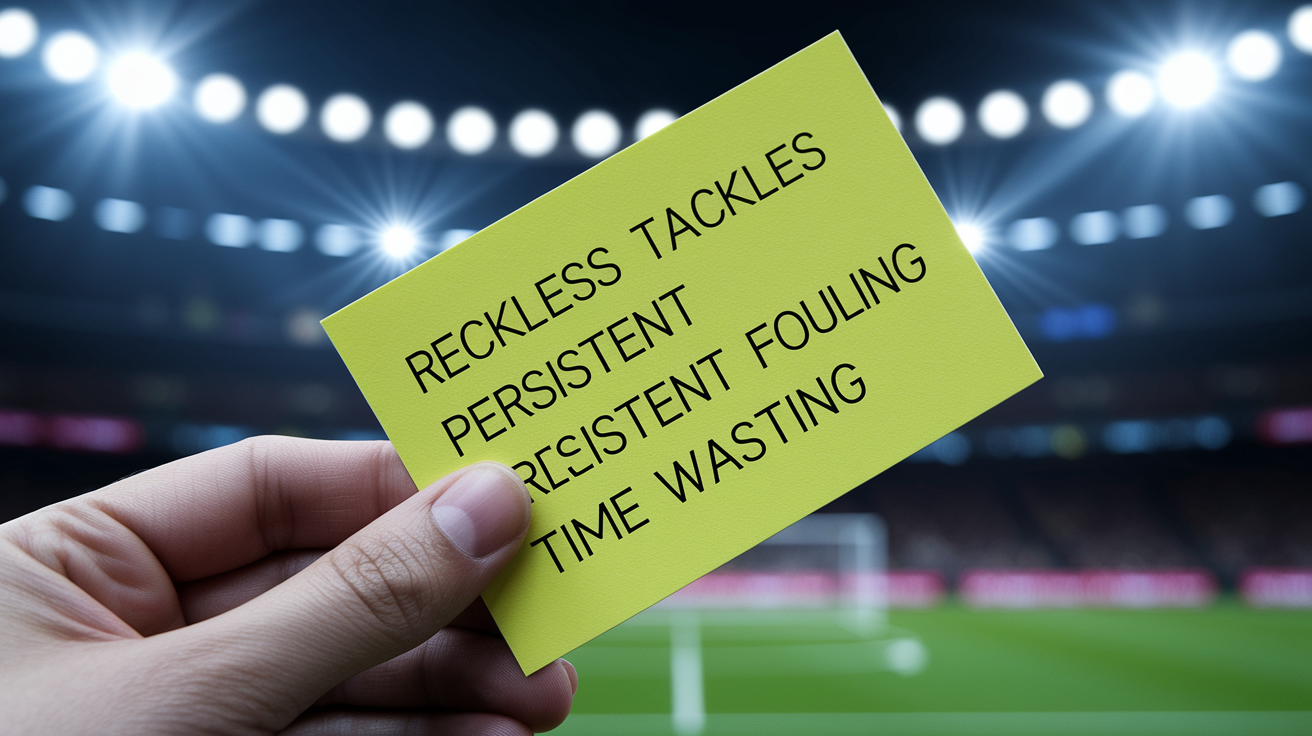
A yellow card is the referee’s way of saying you’ve crossed a line, but you’re not out yet. It’s a warning with teeth. You don’t leave the field, but the card stays with you until the final whistle. Get another and you’re done. Most players dial it back after a booking. Risky tackles become calculated risks. Arguments get swallowed.
Yellow cards get shown for:
Reckless tackles: going in hard, missing the ball, catching your opponent awkwardly without being outright dangerous.
Persistent fouling: stacking up small fouls quickly, even if none of them alone would warrant a card.
Time wasting: holding the ball at a throw, taking forever on a free kick, anything to kill the clock.
Dissent: arguing with the ref, waving imaginary cards, making a scene over a call.
Diving: trying to con the ref into giving a foul or penalty by exaggerating contact or faking it entirely.
Not respecting the distance: crowding a free kick when you’ve been told to back up ten yards.
Once you’re booked, you recalibrate. Defenders ease off last-ditch slides. Midfielders think twice before chopping down a counter. Attackers stop tugging shirts or delaying restarts. That yellow creates an invisible leash, and it tightens every decision you make for the rest of the match.
Red Card Meaning, Direct Send-Off Offenses, and Match Impact

A red card is the nuclear option. You’re off, no arguments, no second chances. Your team plays the rest of the match a man down, and no sub can fill your spot. Red cards come in two flavors: straight reds for serious stuff and second yellows when you push your luck too far.
Straight reds are reserved for the worst offenses. Serious foul play means a tackle with zero concern for the other player’s safety. Two-footed lunges, studs up above the ankle, late hits from behind with full force. Violent conduct covers anything off the ball: punches, kicks, headbutts, elbows. Doesn’t matter if you connect or miss.
You’ll see an immediate red for:
Violent conduct: throwing a punch, kicking out, headbutting, elbowing someone when the ball’s nowhere near you.
Serious foul play: tackles that endanger an opponent through excessive force or brutality.
Spitting: zero tolerance, doesn’t matter who it’s aimed at.
Denying an obvious goal-scoring opportunity: fouling or handballing to stop a clear breakaway or goalbound shot when no one’s covering.
Offensive or abusive language or gestures: aimed at anyone, ref included.
When someone gets sent off, the entire team scrambles. The missing player’s role gets absorbed by reshuffling everyone else. Usually an attacker drops back or the defensive shape gets tighter. Pressing becomes dangerous. Transitions slow down. Everyone left on the pitch runs harder and covers more ground, especially if the red comes early.
Two Yellows Equal a Red: How the Second-Caution Dismissal Rule Works

Two yellows in one match equals a red. Simple math, brutal result. The ref shows the second yellow, then immediately follows it with red. You’re dismissed permanently, not benched temporarily. Your team plays with ten for the duration, same as a straight red.
The two yellows don’t need to match. One can be for dissent, the other for a bad tackle. Refs track every caution by jersey number and match minute in their report. Players know when they’re on a yellow. Fatigue hits, frustration builds, desperation creeps in, and suddenly that second card appears. A booked defender makes a tactical foul to kill a counter. A cautioned midfielder argues one call too many. A forward tugs a shirt during a set piece. Second yellow, then red. Match over.
Tactical and Team Adjustments After a Red Card

Going down to ten forces instant compromise. You can’t press the same way, you can’t cover the same space, and you definitely can’t attack with the same freedom. Coaches usually pull back an attacker or midfielder, tighten the shape, and focus on keeping the ball instead of chasing it everywhere.
If you’ve got subs left, you might swap an attacker for a defender or midfielder to rebalance things. If you’re out of changes, players stretch across bigger zones, transitions get pickier, and set pieces become nerve-wracking because you’re missing a body in the box.
| Impact Area | Typical Adjustment |
|---|---|
| Formation | Shift to a more defensive shape (e.g., 4-4-1 or 5-3-1) |
| Pressing | Reduce high press; drop deeper to protect space |
| Substitutions | Sacrifice an attacker for a defender or midfielder |
| Player workload | Increased running and positional coverage for remaining ten |
You can still win with ten if you’re smart about it. Protect leads through disciplined defending, exploit opponent fatigue late, and don’t give away cheap fouls. But the margin shrinks. Every mistake costs more, every transition carries risk, and fitness decides games as the clock runs down.
Accumulation Rules, League Suspensions, and Competition-Specific Disciplinary Policies

Yellows pile up across matches in the same competition. Most leagues hand out automatic suspensions when you hit a threshold. Five yellows often means a one-match ban, usually enforced around a specific matchday like matchday 19. Some leagues reset the count midseason or before knockout rounds. Others carry totals straight through.
Red-card bans depend on what you did. A second yellow usually gets you one match. A straight red for serious foul play typically means one to three games. Violent conduct, spitting, or abusive language can stretch into three-plus matches, with disciplinary panels reviewing footage and match reports to decide the final number. Really bad incidents can stack on extra games and fines.
Cup competitions run their own accumulation rules. At the World Cup, two yellows in separate group or knockout matches gets you suspended for one game. Yellow counts might reset after certain stages, but red-card bans carry over unless stated otherwise. Domestic cups might not share totals with league play, so you could be suspended in the league but still eligible for a cup match the same weekend. Depends on the federation.
VAR, Appeals, and Overturned Card Decisions

VAR lets officials review potential reds in real time. If the video assistant spots a possible send-off the on-field ref missed, or sees clear evidence a red was wrong, the ref gets called to the monitor. After watching the replay, they can upgrade a yellow to red, downgrade a red to yellow, or stick with the original call.
Some reds get overturned on appeal after the match. Clubs send in video and written arguments to the disciplinary committee, which reviews the incident and match report. If the panel finds a clear error, the red gets wiped, the suspension lifted, and the player’s record cleared. Appeals work best for mistaken identity or cases where contact was minimal but called violent.
Common reasons cards get overturned:
Mistaken identity: the ref booked or dismissed the wrong player and footage proves it.
Minimal or no contact: a red for violent conduct where video shows little to no actual contact.
Ball contact on a DOGSO foul: evidence the defender got the ball cleanly and didn’t actually foul anyone.
Exaggerated simulation: the dismissed player was sent off for a foul that turned out to be embellished or faked by the opponent.
Famous Send-Offs and Historical Flashpoints Illustrating Card Severity

Big red cards show what’s at stake. Zinedine Zidane headbutted Marco Materazzi in the 2006 World Cup final during extra time. Red card, off he went, and France lost on penalties. One of the most replayed and debated send-offs ever. Violent conduct in the biggest moment.
David Beckham got sent off in the 1998 World Cup Round of 16 against Argentina for kicking out at Diego Simeone while on the ground. England played most of the match down a man and lost on penalties. Beckham took years of heat for it. Even a small retaliation can wreck everything.
Luis Suárez deliberately handballed on the goal line in the 2010 World Cup quarter-final against Ghana. Denied a certain goal, got a red card and a one-match ban. Ghana missed the penalty. Uruguay advanced. Sometimes the red card punishment still works out for the team that commits the foul.
Pepe’s dismissal for Real Madrid against Getafe in 2009 earned him a ten-match suspension for violent conduct. One of the longest bans handed out in that competition.
- Zinedine Zidane (2006 World Cup final): headbutt, red card, France lost on penalties.
- David Beckham (1998 World Cup Round of 16): kicked Simeone, sent off, England lost.
- Luis Suárez (2010 World Cup quarter-final): handball on the line, red card, Ghana missed penalty, Uruguay through.
- Pepe (Real Madrid vs Getafe, 2009): violent conduct, ten-match ban.
How Players and Coaches Reduce the Risk of Yellow and Red Cards

Discipline starts with keeping your head. Players who don’t retaliate, who don’t argue every call, who walk away from confrontations, they get fewer cards. Coaches drill this in: channel your fire into positioning and work rate, not reckless tackles.
Better tackle technique helps. Defenders who stay on their feet, time their challenges, avoid lunging from behind, they don’t rack up yellows. Midfielders who know when to pull out of a 50/50 and attackers who don’t dive cut their booking rate too. Positional awareness keeps you from becoming the last man and facing a DOGSO red by always having cover.
Habits that keep the cards away:
Stay composed after fouls or bad calls: no gestures, no crowding the ref, no theatrics.
Master clean tackling: lead with the right foot, stay low, don’t go in two-footed or studs up.
Know when to let it go: pulling out of a dangerous challenge saves you from both injury and cautions.
Respect the ten-yard rule: back up when told, don’t get a cheap yellow for encroachment.
Talk calmly with teammates and officials: captains and senior players set the tone by staying respectful.
Understand your competition’s rules: knowing accumulation limits and thresholds helps you manage your card count across a season.
Final Words
In the action, a yellow card is a caution, the player stays on and must change behavior, while a red is an immediate send-off that leaves the team a player short.
We ran through meanings, the two-yellow-equals-red rule, tactical fallout after dismissals, accumulation and VAR, and simple coach-led prevention steps.
The difference between yellow and red cards in soccer explained here should help you spot how one card can swing a match. Stay tuned — it makes watching games smarter and more fun.
FAQ
Q: What is the difference between yellow card and red card in soccer?
A: The difference between a yellow card and a red card in soccer is that a yellow is a caution letting the player stay on the field, while a red is an immediate send-off and the team plays one man down.
Q: How many yellows before a red?
A: How many yellow cards before a red is two in the same match; two cautions automatically convert to a red, causing immediate dismissal and the team to play a player short.
Q: Is a red card a 3 match ban?
A: Whether a red card is a three-match ban depends on the competition and the offence; violent conduct often brings multi-game bans, while some send-offs carry a one-match suspension.
Q: Can a head coach or sub player get a yellow card?
A: A head coach or substitute player can receive a yellow card; managers, substitutes, and technical staff may be cautioned for misconduct and can also be shown a red and sent off.